Narrated with AI · Script by Jay William
Narrated with AI

Jay William
Founder | Villa Marketers
25 Years in Hospitality, Direct Bookings, and Vacation Rental Marketing
Direct Bookings • SEO • AI Tools • Branding • Advertising • Owner Acquisition • Growth Systems
- Last Updated
- June 2026
- Reading Time
- 14 min read
- Reviewed for Accuracy
- June 2026
Here's the line worth remembering before anything else in this guide: branding isn't what you think it is. It's what other people feel it is.
That's not a clever turn of phrase, it's the entire mechanism. You don't get to decide your brand. You only get to decide what you put into the world, the photos, the words, the way you respond to a guest at 11pm when something's broken. What people actually feel after all of that, that's the brand. And it's happening whether you're deliberate about it or not.
This article is the philosophy. If you'd rather see the deliverable, we package the whole identity, our vacation rental branding and logo design service turns everything below into a done-for-you brand system.
Logo, brand identity, brochures, and social ad creative in one cohesive package.
The feeling someone has about your business after every interaction adds up, your photos, communication, reviews, and follow-up. You shape it; you don't control it directly.
No. A logo is a visual mark for the brand. The brand is the accumulated feeling and reputation behind it.
In the story a guest tells themselves afterward, formed across three stages: Expectation, Experience, and Story.
As short as it can be while keeping real meaning, often four to six words, so a guest can carry it around without thinking.
You don't have one brand. You have thousands.
Here's the part that surprises most owners: your brand isn't singular. It exists separately, in the mind of every single person who's ever encountered it.
One guest had a flawless week and left thinking of you as a five-star experience. Another guest hit a hiccup, a slow response, a confusing checkout process, and now carries a three-star version of you around in their head, even if the property itself was identical. Both of those are real. Both of those are your brand, just two different copies of it, formed by two different experiences.
Guest A
★★★★★
Flawless week. Five-star story.
Guest B
★★★☆☆
One slow reply. Three-star story.
Guest C
★★★★☆
Great stay, confusing checkout.
That's why branding can't be controlled the way a logo can. You can't edit someone's memory. What you can do is stack the odds: make every single touchpoint, your website, your listing photos, your communication, your follow-up, consistent enough and good enough that most of those thousands of copies end up landing somewhere close to the same place.
Expectation, Experience, Story: where your brand actually lives
Here's why the “thousands of brands” idea is true, not just a vivid way of putting it. A guest doesn't walk away carrying a literal recording of their stay. They carry the story they tell themselves, and later, their friends, about it. That story is where your brand actually lives.
Every stay runs through the same three stages. Closing the gap between them, consistently, is the actual mechanism behind everything else in this guide.
Before arrival
Expectation
Set by your photos, listing copy, reviews, and the communication leading up to check-in.
During the stay
Experience
What actually happens, the property itself plus every interaction along the way.
After they leave
Story
The version of events the guest settles on and repeats. This is where your brand lives.
This isn't a stretch from how memory genuinely works. Experiences tied to real emotion get encoded and recalled far more readily than neutral, forgettable ones, that's well-established and doesn't need exaggeration to be true. A guest whose expectation and experience matched cleanly tells a simple, positive story. A guest whose experience fell short of expectation, even over something minor, tends to remember and retell the gap, not the good parts that surrounded it.
This is also exactly why a bad review so rarely matches the actual quality of a property. It's almost never “the house was bad.” It's “this wasn't what I expected.” Your brand is what sets that expectation in the first place. One of the simplest tools for closing that gap on purpose, a short, direct message setting clear expectations before arrival, is something we go deeper on in our guide to spotting and preventing guest mismatches.
What branding actually is
Branding is the sum of everything: your website, your photos, your communication style, your interior design, your values, your service, the actual guest experience, and how all of that adds up into a feeling. It's your reputation, and reputation isn't something you state, it's something you earn one interaction at a time.
What branding isn't
A logo isn't your brand. It's a mark, a symbol, a visual shorthand for the brand, but the brand itself lives somewhere deeper than a graphic.
Your property isn't your brand either. People say “I prefer this brand” the way they might say “I prefer this property,” but the property is just one part of a much bigger experience.
Branding also isn't a slogan, a story, or a mission statement on its own. Those are tools that help express the brand. None of them is the brand.
Why small vacation rental businesses need this more, not less
There's a common excuse worth retiring: “branding is for big companies.” It's backwards. A small operation needs branding more than a giant one does, because a giant brand has decades of accumulated reputation to absorb the occasional bad experience. A single host or a small portfolio doesn't have that cushion. One unaddressed hiccup can define the whole relationship with a guest who never comes back.
Without a deliberate brand, you default to being a commodity, competing purely on price. Branding is how you stop competing on price and start competing on the feeling only you can deliver.
The order to actually do this in
Most branding advice throws a dozen tasks at you with no sequence. Here's the order that actually works, each step makes the next one easier.
- 1
Decide what you want people to feel
Not what you want to say, what you want them to feel. Confident? Pampered? Like they found a hidden gem? Get specific, “great service” is too generic to build anything on.
- 2
Define your personality
If your brand were a person, what would they be like? Warm? Sharp? A little irreverent? Airbnb's personality, welcoming, adventurous, community-minded, shapes everything from their photography to their copy. Yours should be just as intentional, even at a smaller scale.
- 3
Build your visual identity around that personality
Color does real emotional work, it affects mood and perception, even though the specific “X% of judgment is color” figures online vary wildly and rarely trace to a real source. What's worth taking seriously: color meaning isn't universal. White signals purity in the US; in parts of China it's associated with mourning. For an international audience, that matters before you lock a palette.
- 4
Write your story, and your About Us page, properly
The single highest-leverage piece of content most hosts skip or phone in. We built a full, dedicated guide to doing this right: Creating the Gold Standard About Us Page .
- 5
Craft your slogan
The short, repeatable line that captures the feeling in a handful of words. More on exactly how below, it's its own discipline.
- 6
Deliver the brand consistently, through the people who aren't you
Housekeepers, co-hosts, reservationists, anyone who touches the guest experience is shaping the brand whether you've briefed them or not. A guest doesn't separate “the host” from “the cleaning crew,” it's all one experience.
One good stay doesn't build a brand. Consistency does.
A single excellent guest experience doesn't make you a five-star brand in the market's mind. It makes you one good story among many unrelated ones. A brand forms when the same story gets repeated, by different guests, independently, often enough that it stops looking like luck and starts looking like identity.
This is where the same business can carry genuinely different brands depending on how it's positioned. The same person could own all three of these, and each one should feel like a different promise, because they're delivering a different feeling to a different guest.
Laid-back, salt-air, unpretentious
A block from the beach, built for travelers who want easy and authentic.
Intimate, secluded, a little magical
Built for anniversaries and couples, not families looking for bunk beds.
Spacious, wholesome, easygoing
Room for everyone, designed around the multi-generational trip.
The treehouse that tries to also market itself as family-friendly waters down both stories. The surf shack that leans formal and upscale is solving a problem nobody staying there actually has.
The Brand Consistency Checklist
A fast way to check whether you actually have a consistent brand yet, or just a collection of disconnected touchpoints: do all eight of these feel like they came from the same business?
- Your website
- Your guest emails
- Your house guidebook
- Your welcome message
- Your photography
- Your checkout instructions
- Your review replies
- Your social posts
If you can picture all eight side by side and they don't feel related, that's not a brand yet, that's a set of individually fine pieces that haven't been pulled into one identity.
Naming your brand: the actual process
If you're starting from nothing, here's a real, repeatable process, not theory, a workflow that actually produces a usable name.
Get a few people in a room, or even just a few honest opinions on a call, and brainstorm without filtering yourself. Write down everything, including the bad ideas, a few weak options on the page make the strong ones easier to spot by contrast. Cut ruthlessly afterward, then bring in a second, third, even fourth opinion before you fall in love with anything. Narrow a long list down to a handful of finalists, then check domain availability before you get attached, a brilliant name with no available domain is a dead end, and domain squatters can make buying your way around that expensive.
Once you have a name, give the logo real attention without overspending your energy on it, it's a visual mark, not the brand itself. Sketch rough ideas before handing them to a designer, it's far easier to give useful feedback on a concept than to describe one from nothing. And confirm it actually works small: a logo that looks great full-size but turns into mush as a tiny social profile photo will quietly undercut you everywhere that matters most.
Your slogan: the short line that does the heavy lifting
A slogan and a tagline aren't quite the same thing, and most hosts have neither.
Your permanent banner, the long-term line tied to your core identity. Disneyland's “The Happiest Place on Earth” has stayed essentially unchanged for decades.
More like a campaign tool, shorter-lived, adaptable, built to support a specific message or moment.
Here's the part that matters more than the label: shorter is almost always stronger. There's real cognitive science behind this, not just a marketing opinion. Research on working memory, most notably Cowan's widely cited “magical number four” (2001), suggests people's short-term recall genuinely tends to max out around four chunks of information, not the often-quoted seven. That's part of why the tightest, most memorable slogans in the world tend to land in the four-to-six-word range: Nike's “Just Do It,” McDonald's “I'm Lovin' It,” Disney's “Where Dreams Come True.” Short enough to repeat without thinking. Sharp enough to stick.
The goal isn't hitting an exact word count. It's making every single word earn its place. A six-word line that lands emotionally can still outperform a generic four-word one. But the shorter you can make it without losing the feeling, the easier it is for a guest to actually carry it around in their head.
One slogan doesn't have to be the ceiling, either. Bigger operations can think in layers: one anchor line for the overall brand, and a distinct, shorter line for each individual property, tied to that property's specific feeling. A mountain cabin and a beachfront villa don't need to share a slogan, they're selling two different feelings. The anchor brand line goes in your host profile and on your website. Each property's own line can live in that property's listing title or description. Guests don't just remember the address, they remember the line that captured what it actually felt like to stay there.
If you want to see this same instinct taken to its boldest, most unapologetic extreme, that's exactly the lane our sister company Knokx lives in. Where Villa Marketers' voice stays refined and direct, Knokx's whole identity is built around being loud, blunt, and impossible to ignore. Different audiences need different registers. Knowing which one is actually yours is part of doing this well.
AI doesn't replace your brand. It magnifies it.
AI tools can now write in something close to your voice, summarize your reviews, answer guest questions, and draft content faster than ever. None of that replaces the work in this guide, it just changes how fast the result shows up.
AI faithfully scales the inconsistency, generating content and responses that drift in tone exactly the way your own communication already does, just at higher volume.
The same tools become a force multiplier, applying a clear identity faster and more often than you could by hand.
AI doesn't fix a fuzzy brand. It just produces fuzziness at a higher volume.
Don't let your own marketing undo the work
A brand can be undermined by something as simple as a website that auto-plays music the moment someone opens it, the kind of jarring surprise that makes a visitor immediately close the tab rather than feel anything you intended. Every touchpoint either reinforces the feeling you're building or quietly works against it. None of this is set-it-and-forget-it. It's something you maintain the same way you maintain the property itself.
Every guest leaves with two souvenirs. One is the vacation itself. The other is the feeling your business created along the way. The first one fades. The second one is your brand.
Vacation rental logo design that earns a premium
A vacation rental logo is not decoration. It is the first trust signal a traveler sees, often before they've read a single line of your copy. It has to hold up at thumbnail size in a listing, on a welcome sign at the door, printed on the cover of a welcome book, and inside the header of an email opened on a phone. If it collapses in any one of those places, the brand behind it starts feeling smaller than the property actually is.
Vacation rental logo design also has to carry a sense of place. Coastal, mountain, desert, city — the mark should hint at where you are, so a returning guest recognizes it the second time and a new guest instantly understands the register they're stepping into. A generic mark caps your nightly rate the same way a bad lead photo does: it doesn't lose you the booking outright, it just quietly pulls your ceiling down.
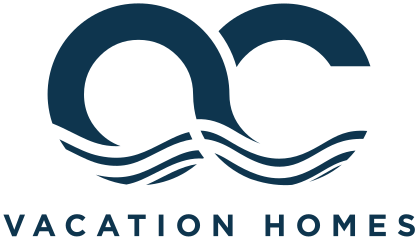
Ocean City Vacation Homes
An "OC" monogram built from ocean waves. The letters carry the market and the water at the same time, so the mark reads correctly on a beach-town listing thumbnail without needing to spell the destination out.
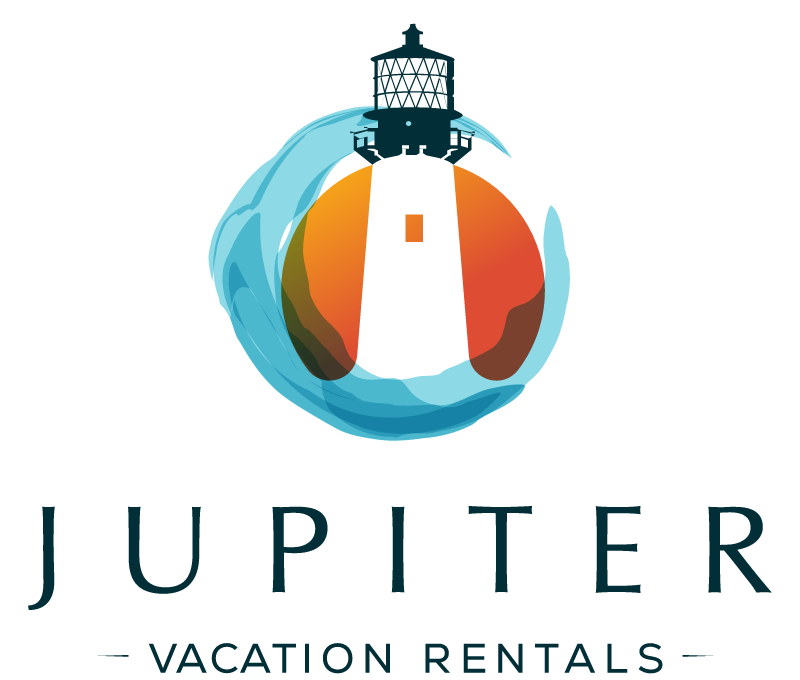
Jupiter Vacation Rentals
A lighthouse-inspired mark for the Palm Beach and Jupiter, Florida market. The lighthouse is a real, recognizable landmark for guests planning that trip, so the logo does geographic work the property name alone can't.
Neither mark is decorative. Both were built to survive the environments a vacation rental logo actually lives in — small on a phone, large on a sign, flat on a printed page, framed inside a video intro. That is the bar we hold vacation rental logo design to whenever we build one for a client.
FAQ
What is branding, in the simplest possible terms?
Branding is the feeling someone has about your business after adding up every interaction they've had with it, your photos, your communication, your reviews, your follow-up. You don't control the feeling directly. You control what you put into the world that shapes it.
Why do you say a guest's “story” matters more than their actual experience?
Because a guest doesn't carry around a literal recording of their stay, they carry around the version of events they settled on afterward. Expectation, set before arrival, experience, what actually happens, and the story that results are the three stages every brand impression actually moves through. A small gap between expectation and experience often gets remembered and retold more than everything that went right around it.
What's the fastest way to close the expectation gap before it turns into a bad review?
Set the expectation deliberately, in writing, before the guest ever arrives, rather than leaving it to whatever your photos and listing copy happened to imply. A short, clear message covering exactly what to expect and what's required of the guest resolves most of the same mismatches that otherwise surface mid-stay as frustration, and later, as a review that has very little to do with the actual property.
Is a logo the same thing as a brand?
No. A logo is a visual mark representing the brand. The brand itself is the accumulated feeling and reputation behind that mark, built through actual experience, not graphic design.
Do small vacation rental owners really need to think about branding?
Yes, arguably more than large companies do. A big brand has years of built-up reputation to absorb an occasional bad experience. A small operation doesn't have that cushion, which makes deliberate branding more important, not less.
What's the difference between a tagline and a slogan?
A tagline is a long-term, stable line tied to your core identity, meant to last for years. A slogan tends to be shorter-lived and more adaptable, often built around a specific campaign or message. Many small businesses get by with just one strong line doing both jobs.
How short should my slogan actually be?
As short as it can be while still carrying real meaning. Research on working memory suggests people tend to hold roughly four chunks of information in short-term recall, which is part of why four-to-six-word slogans tend to outperform longer ones. The goal isn't a strict word count, it's making every word earn its place.
Can different properties in the same portfolio have different slogans?
Yes, and for a multi-property operation it often works better than forcing one line to cover everything. One overarching brand line, plus a distinct, shorter line for each property tied to that property's specific feeling, gives guests something concrete to remember about the exact place they stayed.
Do you design vacation rental logos?
Yes. Vacation rental logo design is part of the branding work we do at Villa Marketers, always tied to the property's positioning and market. Two examples from our own portfolio: Ocean City Vacation Homes uses an "OC" monogram built from ocean waves, and Jupiter Vacation Rentals carries a lighthouse-inspired mark for the Palm Beach and Jupiter market. In both cases the logo signals the place first and the company second.
What makes a good vacation rental logo?
A good vacation rental logo works at thumbnail size in a listing, prints cleanly on a welcome sign, sits well on a welcome book, and doesn't collapse into a smudge inside an email header. It should carry a sense of place — coast, mountain, desert, city — and be distinctive enough that a repeat guest recognizes it the second time they see it. A generic mark caps your nightly rate the same way a bad lead photo does.
Turn your brand from something accidental into something deliberate
Want help turning your brand from something accidental into something deliberate? This is exactly the kind of identity, naming, and messaging work we help hosts and property managers build from the ground up.
Ready for the done-for-you version? Our vacation rental branding and logo design service bundles logo, identity, brochures, and social ad creative into one package.
Part of one connected body of work
These flagship guides build on each other. Each one is part of the same direct-booking system.
Jay William
Founder, Villa Marketers · Co-Founder, Knokx
Jay William is the founder of Villa Marketers and co-founder of Knokx, with 20+ years helping vacation rental brands grow beyond OTA dependence. His work focuses on direct-booking strategy, SEO and AI visibility, brand positioning, and owned demand systems for hosts and property managers.
Industry peers call him The Father of Vacation Rental Marketing.
- Direct Booking Strategy
- SEO & AI Visibility
- Brand Positioning
- Property Manager Marketing
- Owner Acquisition