Vacation Rental Marketing Playbook / Photography
The Flagship Guide
Vacation Rental Photography
They buy with their eyes. Which means your photos are not documentation — they are the first handshake, and most owners are losing the deal in the first frame.
Key takeaway
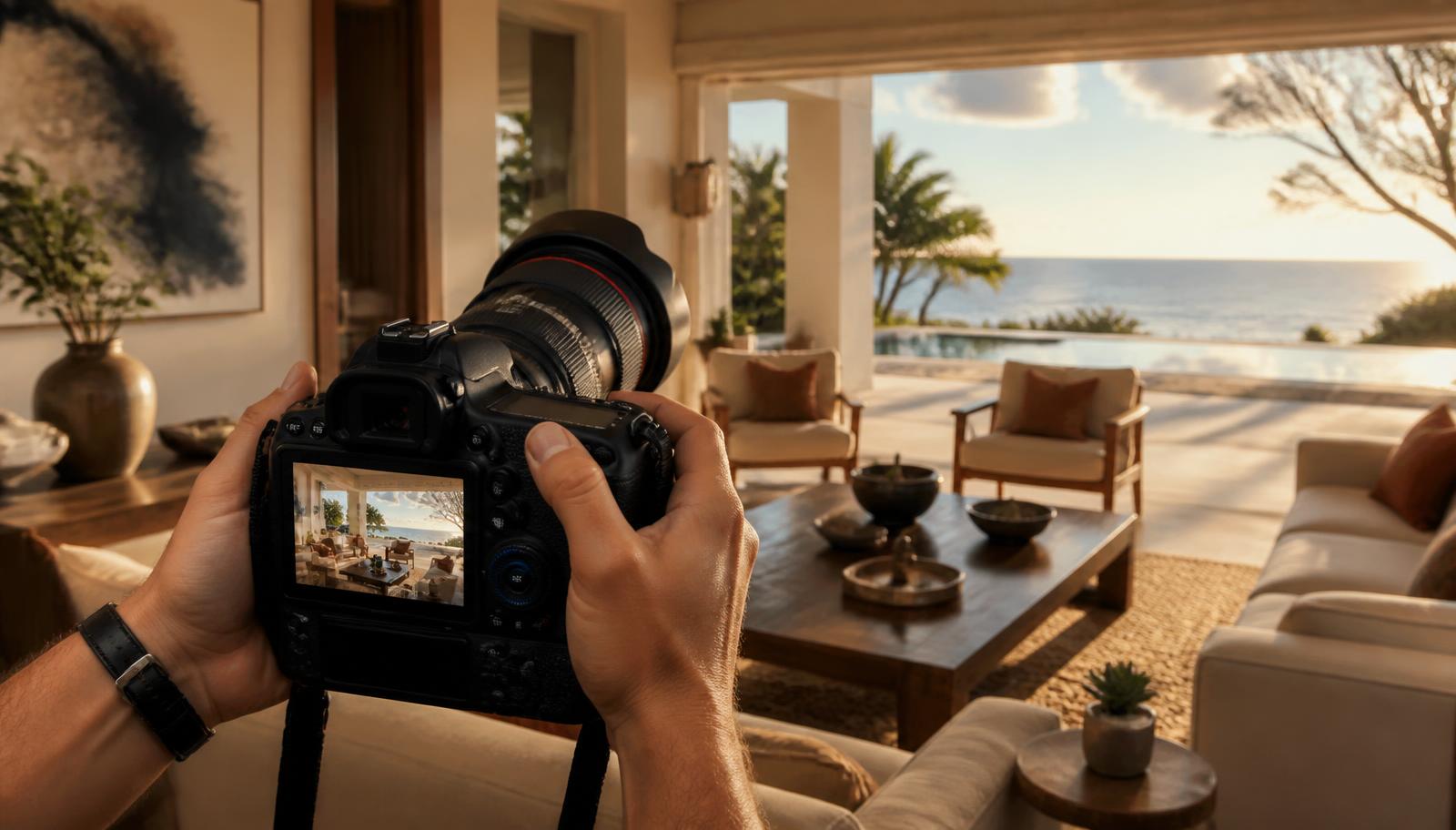
Vacation rental photography is an emotional argument, not a record of a building. Travelers buy with their eyes, so the job is to make them feel something in the first frame and then lead them through the property like a guided tour. Shoot bright, light and airy, use a wide lens and a tripod, get low for depth, and shoot the experience — the water, the walkable street, the beach chairs — not just the unit. Edit honestly: enhance reality, don't invent it. And if a guest tells you the photos didn't do it justice, that is not a compliment. That is a leak.
I have been marketing vacation rentals since 2005, and in that time I have watched owners agonize over nightly rates, rewrite their listing copy four times a season, and argue about which channel manager to buy — while the photos at the top of the page, the only thing anyone actually looks at, stay exactly as bad as they were the day the property went live.
Here is the whole thing in one sentence, and it is the sentence I have repeated for twenty years: they buy with their eyes. The eyes are the window to the soul, and emotion is what touches the soul and makes them react. Nobody reads their way into a booking. They feel their way into one, and then they read to justify the feeling they already had.
So photography is not documentation. It is not a compliance exercise where you prove the property has four walls and a bed. It is the emotional first handshake with a guest, and like every first handshake, you get one.
What is in here
01They buy with their eyes
Every traveler shopping for a place to stay is doing the same thing: scrolling a grid of thumbnails at speed, making a yes-or-no judgment in a fraction of a second, and only then reading anything. Your title, your amenity list, your carefully worded description of the coffee situation — none of it gets a hearing until the photograph has already won the argument.
That is not a modern phenomenon caused by phones. It is how people have always evaluated places they cannot visit. What phones changed is the speed and the volume of the comparison. Your property is not being judged in isolation; it is being judged against eleven other thumbnails on the same screen, half of which were shot by a professional.
The eyes are the window to the soul, and emotion is what touches the soul and makes them react.
The practical consequence of that is a shift in what you are trying to accomplish with a camera. You are not trying to inventory the property. You are trying to make somebody feel the specific thing they will feel when they walk in the door — the light on the floor at seven in the morning, the way the room opens toward the water, the fact that this is the kind of place where you actually put your feet up.
That is emotion, and emotion is the only thing that converts a scroll into a click. It is the same argument I make about storytelling and about building a real brand: the mechanics of the business are commodity, the feeling is not. Photography is simply the fastest delivery mechanism for that feeling that exists.
In my experience, strong photography can lift a property's perceived value by as much as 50 percent. I want to be precise about what that claim is: it is a rule of thumb from two decades of watching the same properties re-shot and re-listed, not a figure I am citing from a study. I have watched a listing hold its rate, fill more of its calendar and attract a noticeably better guest after nothing changed except the pictures. That is what I mean by perceived value, and it is why photography is the highest-leverage line item in most owners' marketing budgets — and why it is the first thing we replace when we take on vacation rental marketing for a property.
02The red flag: "the photos don't do it justice"
Now the part that most owners get exactly backwards, and the reason I wanted to write this page at all.
A guest checks in, walks through the door, looks around and says: "Wow — the photos don't do it justice." Or the review lands a week later: "It's even better than the pictures!" The owner reads that and glows. They screenshot it. They put it on the website.
Read this twice
"It's better than the photos" is not a compliment. It is a diagnostic. It means your photography is under-selling the property — and everything that costs you happened before that guest ever booked.
Think about what that sentence actually reports. It reports a gap between what the property looked like online and what it is in real life, with the online version being the weaker one. The guest in front of you closed that gap by showing up. Fine. But that guest is the survivor. What about everybody who saw the same weak photos, felt nothing, and scrolled past?
You will never meet those people. They do not send you feedback. They do not leave a review explaining that your third bedroom looked cramped and yellow so they booked the place down the road. The under-sell is invisible by definition, which is exactly why so few owners ever catch it — the only signal it produces is a compliment.
The target is not "better than the photos." The target is this, said by a guest standing in your entryway: "This is exactly what I paid for." Precise. Congruent. No gap in either direction. That is what a well-photographed property produces, and the reason it matters is arithmetic: get the front end right and you attract more of the right guests, at the rate you want, from the same amount of traffic.
The surprise belongs in the stay, not in the listing
People push back on this, and the pushback is always the same: don't you want to delight guests? Isn't it good to over-deliver?
Yes. I believe in delight and surprise more than most people in this industry. But the surprise belongs in the actual stay — the handwritten note, the local pastries, the thing you remembered from their booking message, the detail nobody advertised. That is delight you engineered.
Weak photography is not delight. It is a manufactured surprise you got by accident because your pictures were bad, and you paid for it in the bookings you never got. Do not confuse a marketing failure with hospitality. Sell the property accurately at its best, then surprise them once they are inside.
03The honest-AI rule: enhance reality, don't invent it
Which brings us straight into the argument everybody is having right now about AI and editing, and where the line sits.
My position is not the cautious one. I am for AI in photography. It has collapsed the cost of work that used to require a retoucher and a week, and for an owner in a market with no professional photographer it is the difference between decent photos and no photos. Use it. But there is one hard line, and it is not negotiable.
The rule
Enhance reality, don't invent it.
If the water's brown, don't make it blue. If there's an obstruction, be honest about it.
Fair game
Removing a trash can or a parked car. Brightening a room to how the space actually looks to your eye. Capturing the glow you would have caught at golden hour if the shoot day had cooperated. Straightening verticals, correcting colour, cleaning up a distraction. All of this reveals the property honestly at its best — the guest still gets exactly what they saw.
Over the line
Faking a season the guest will never see. Adding a view that is not there. Editing out an obstruction they will actually live with. Anything that changes what the guest will receive. That writes a check the stay can't cash — and it produces the bad first impression, the bad review, and the killed repeat booking.
Notice that this rule is the same thesis as section two, pointed the other way. Under-selling loses you guests you never met. Over-selling loses you the guest you already won, at the worst possible moment — the second they open the door. Both are congruence failures. The whole game is congruence: the photograph promises exactly what the stay delivers, and the guest's first words are "this is exactly what I paid for."
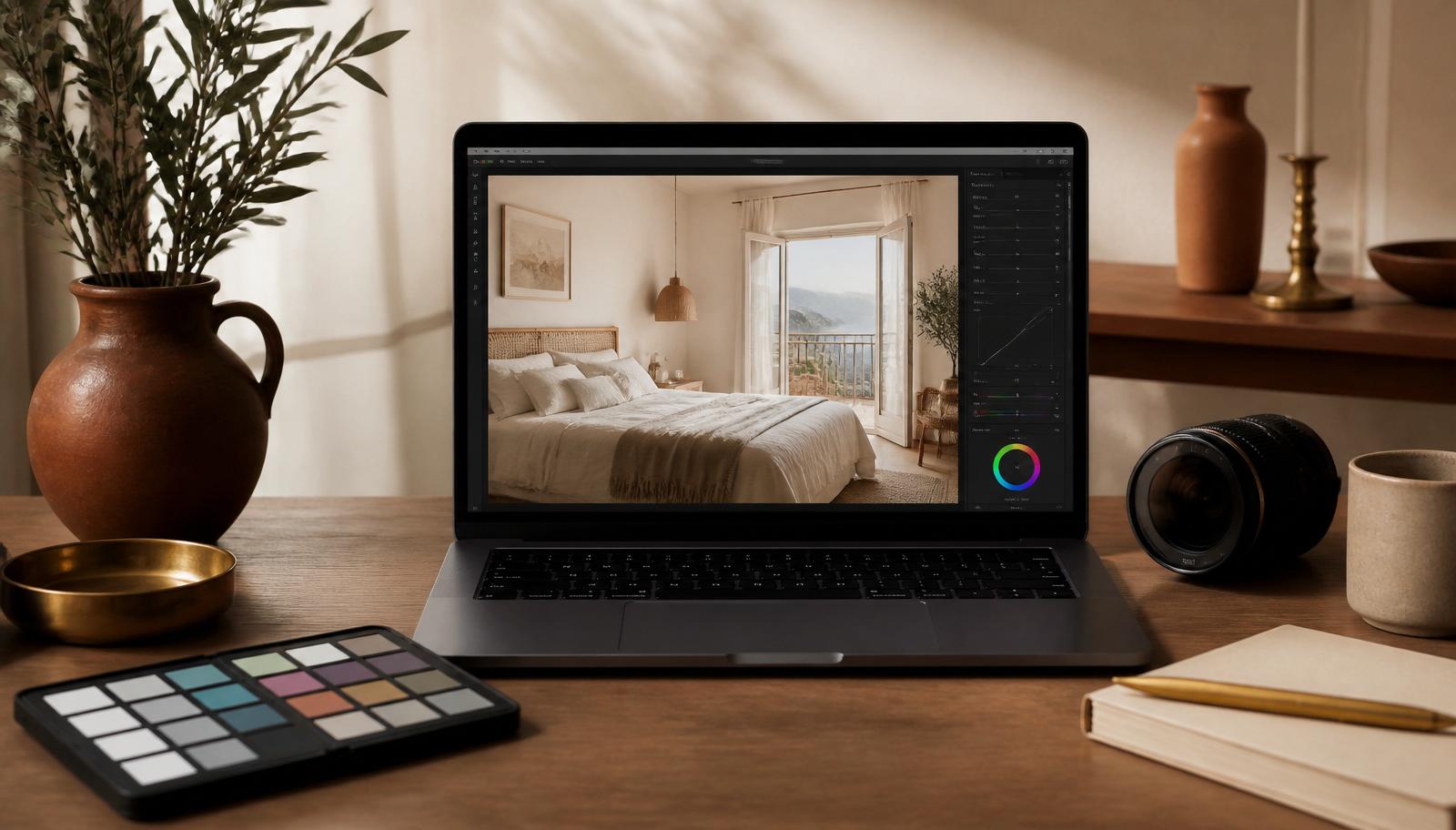
There is a business reason to be rigid about this beyond the ethics. Repeat and referral guests are the cheapest bookings you will ever get, and they are the entire economic argument for owning your direct-booking channel in the first place. An over-edited photo torches that pipeline on arrival day. You do not get to recover it with a nice welcome basket.
04How to actually shoot it
Everything below is what I tell owners when they ask me how to do this themselves. It is not a photography course. It is the short list of things that move the result the most.
Hire a professional if you possibly can
That is still the best advice I have, and I am not going to bury it under caveats. A professional brings the lens, the lighting judgment and — more importantly — an outside eye that sees the clutter you have stopped seeing. If a real estate or interiors photographer works your area, book them.
If there is not one, today's technology genuinely helps. AI editing, a decent camera, or even your phone if you are strategic about it will get you a long way further than the same setup would have in 2010. The excuse of "there's no photographer near me" no longer justifies bad photos.
Gear: wide lens, DSLR if you have one, tripod always
- A wide lens. This is the single most important piece of gear. Interiors shot on a normal lens read as cramped because you physically cannot back up far enough. Wide captures the whole space the way a person standing in it perceives it.
- A DSLR if you have access to one. Not for snobbery — for the raw file. A DSLR gives you the raw quality to then manipulate properly in editing tools like Adobe Photoshop, and now AI can do much of that work for you. You cannot recover detail that was never captured.
- A phone, used strategically. Modern phones are more than capable if you respect light, keep the lens level, and shoot the widest option available. Strategic beats expensive.
- A tripod. Every time. It keeps your verticals straight, it forces you to slow down and compose rather than spray, and it lets you shoot in lower light without smearing the frame.
Golden hour, and why cloudy days are a gift
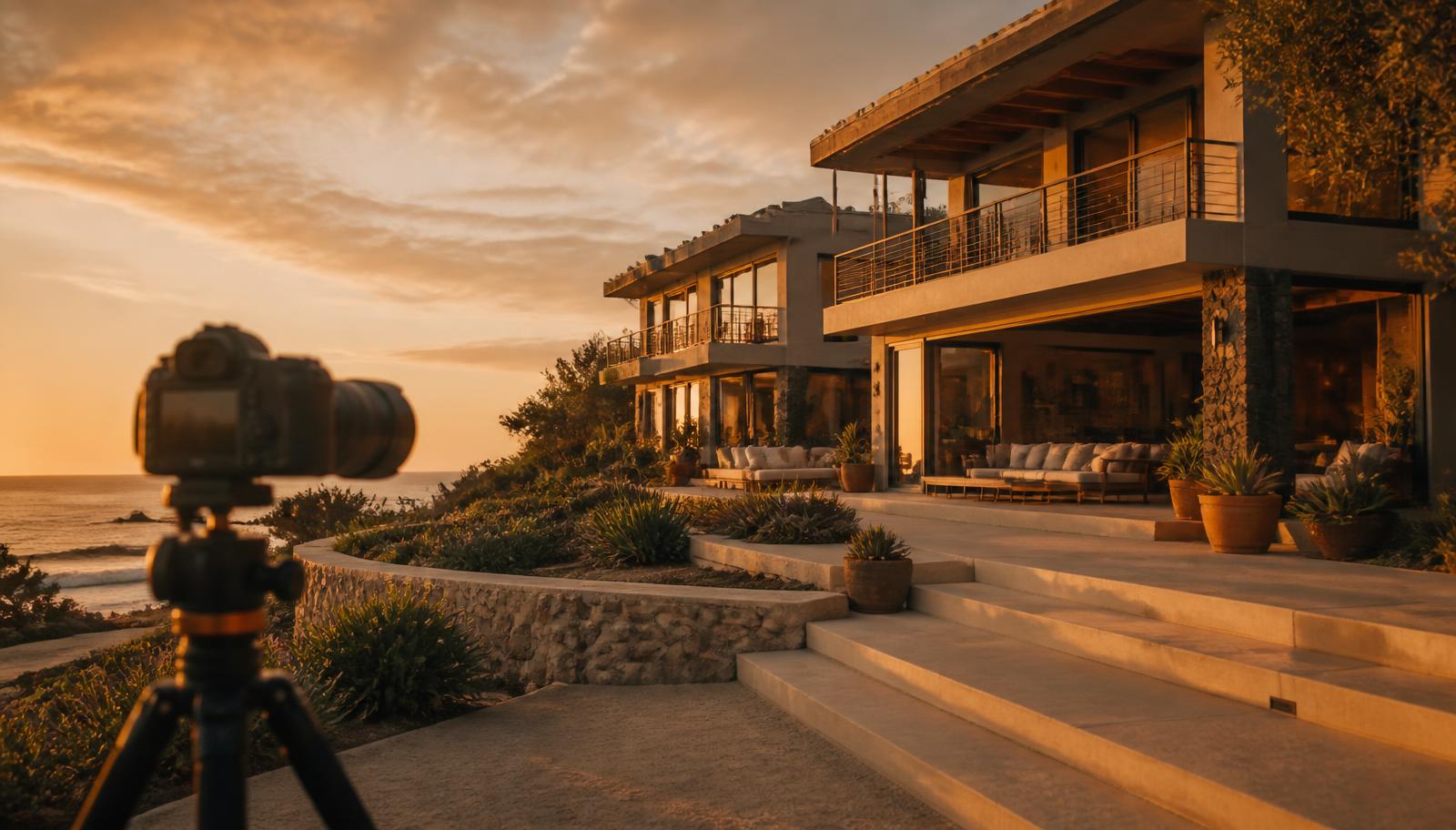
Shoot at golden hour when you can — the hour after sunrise and the hour before sunset. The light is low, warm and flattering, and it does more for a room than any amount of editing will. If you cannot shoot then, you can adapt afterwards with AI, honestly, inside the rule above.
The part owners get wrong: they wait for a brilliant sunny day to shoot the exterior. Don't. Overcast and cloudy days are excellent for exteriors. The cloud layer acts as one enormous filter and gives you soft, even light across the whole facade. Bright direct midday sun does the opposite — it bleaches surfaces, whites out the highlights and drops hard black shadows across everything you were trying to show.
Bright. Light. Airy.
Three words. I have said them to more owners than I can count, and they are the whole aesthetic brief.
Bright means every lamp on, every blind open, and an exposure that reads generous rather than moody. Light means the room feels unweighted — surfaces clear, palette calm. Airy means space to breathe in the frame.
Which requires the least glamorous instruction on this page: declutter ruthlessly. Off the counters, off the nightstands, off the back of the bathroom door. Every object in a frame is a thing the viewer's eye has to process instead of feeling something. Charging cables, cleaning products, the remote, the stack of paperwork, the bin — gone before the tripod comes out. A room shot clean at a mediocre hour beats a cluttered room shot in perfect light, every single time.
Get low: angles, depth, and character
Most amateur interior photos are shot from standing height, which is exactly the angle every other amateur photo was shot from, and it flattens the room.
Kneel down. Shoot from below — below bed level in a bedroom, below counter height in a kitchen. The low angle gives you depth and dynamism, it makes the ceiling read as generous, and it lets the character pieces in the room — the headboard, the rug texture, the light fixture, the thing that makes this property this property — actually register in the frame instead of disappearing into a floor plan.
Bedrooms deserve the most attention here, because the bedroom photograph is doing more emotional work than any other shot in the set — it is where the guest pictures themselves. If the bedroom is not carrying its weight in your gallery, the fix is usually the room, not the camera; that is the whole argument of vacation rental bedroom design.
Sequence the set like a guided tour
A photo gallery is not a folder. It is a sequence, and the order is a decision you are making whether you think about it or not.
Order your images so you are hand-leading the traveler through the property the way you would if you were walking beside them: arrival and exterior, into the main living space, through the kitchen, down the hall, into each bedroom, the bathrooms, out to the deck, then the setting. Continuity matters. The lead photo must match the thumbnail they clicked — if they tapped a shot of the pool and land on a photograph of a hallway, you have broken the thread in the first second.
And cover the whole property. Every room a guest will use, every sleeping space, every bathroom, the outdoor areas. Unanswered questions in a gallery become doubt, and doubt does not book. Then stop — four near-identical angles of the same sofa bury the images that were actually selling.
Show faces
The last one, and it is the one almost nobody does: photograph yourself and your team.
People connect with faces. A photograph of you on the property — and of your housekeeper, your maintenance guy, whoever actually keeps the place running, in branded apparel where it looks natural — turns an anonymous listing into somebody's business. It humanizes the brand in a category where almost every competitor is a faceless set of room photos. It costs you one extra frame.
The brand cues in the frame
Related, and worth doing deliberately: I put subtle brand cues into property photos on purpose. A branded welcome card on the table. A logo on the TV screen — permitted on the major platforms as of now, though that could change. You and your team in branded shirts.
Two things happen. Travelers who saw the listing on a platform can find you off-platform, and guests already inside the property keep meeting your brand. That is the billboard effect, and I am not going to re-explain it here because it is already explained properly in one place: the billboard effect, in the website guide. Read it there, then come back and put a welcome card on the table.
05Shoot the experience, not the unit
Here is where most vacation rental photography stops short, including a lot of professional work.
Nobody is buying a building. They are buying a trip. The property is the base camp for something they have been imagining for months — the morning walk, the meal out, the afternoon where nothing is scheduled. If your gallery only contains rooms, you have documented the base camp and left the trip to the traveler's imagination, and their imagination is busy looking at eleven other thumbnails.
Blue Water Cove: what this looks like in practice
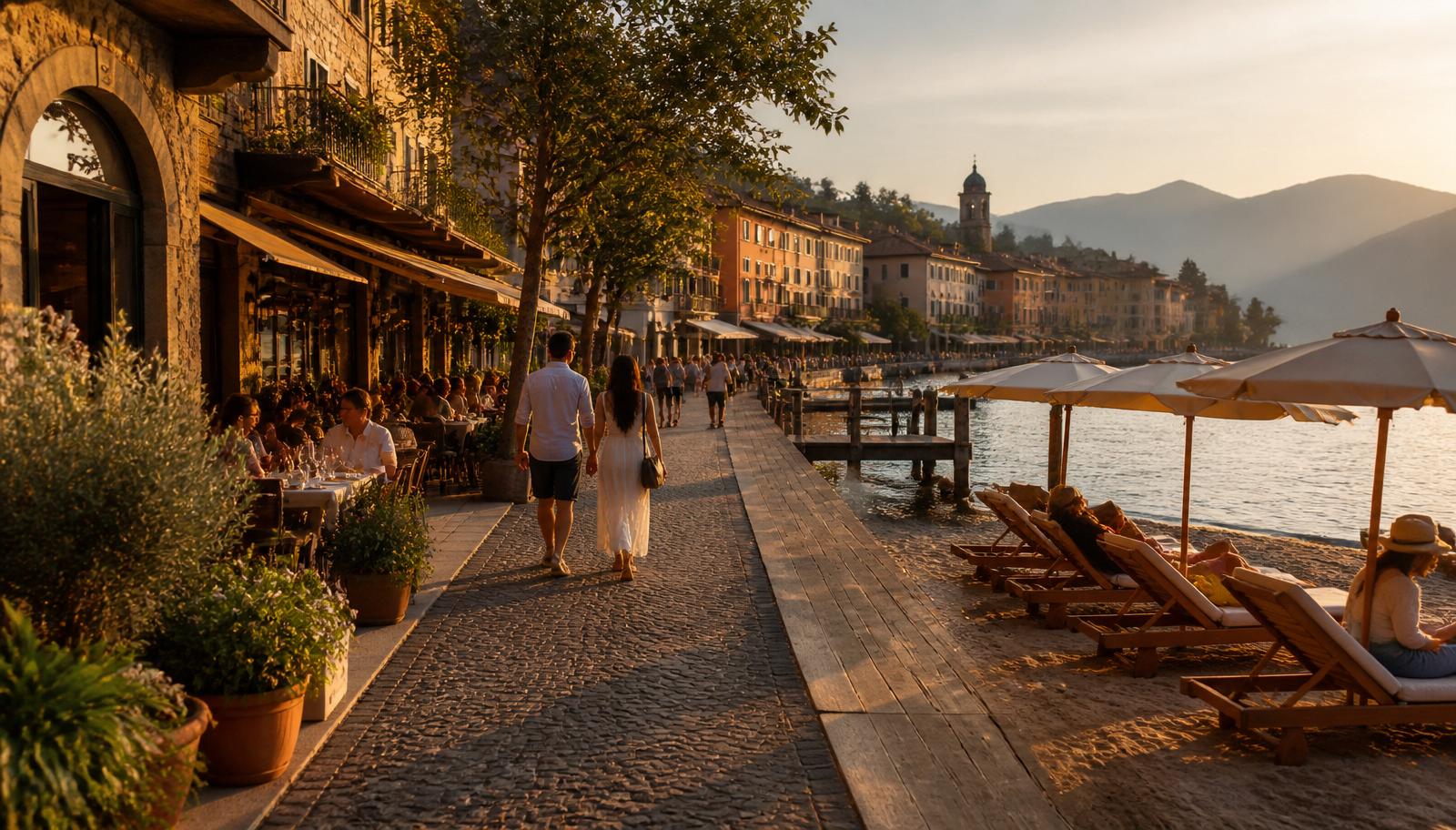
We went to Blue Water Cove and shot it properly — photography and video, on location, capturing the experience rather than an inventory of rooms.
That meant the water: the lake and the river nearby. It meant the walkable restaurants and bars, because "you can walk to dinner" is an entirely different proposition when you can see the street. It meant the shopping. It meant the nearby beach, and the beach chairs you can rent when you get there — a small, concrete, genuinely useful detail that no room photograph could ever communicate and that a traveler planning a family trip actually cares about.
None of that is inside the property. All of it is part of what the guest is buying. You can see how the whole build came together in the Blue Water Cove case study.
The test I would apply to your own gallery: if you removed every interior shot, would a stranger still understand what the trip feels like? If the answer is no, you have photographed a unit.
This is also where photography stops being a one-off expense and starts being a content asset. A proper shoot produces the images your website runs on, the raw material for social, the visuals inside your guides and blog posts — the whole supply chain described in the content marketing pillar, and the fuel for social media, which consumes images faster than any other channel you have. Budget for a shoot day like it is infrastructure, because it is.
06The modern layer: drone and AI
Drone and aerial
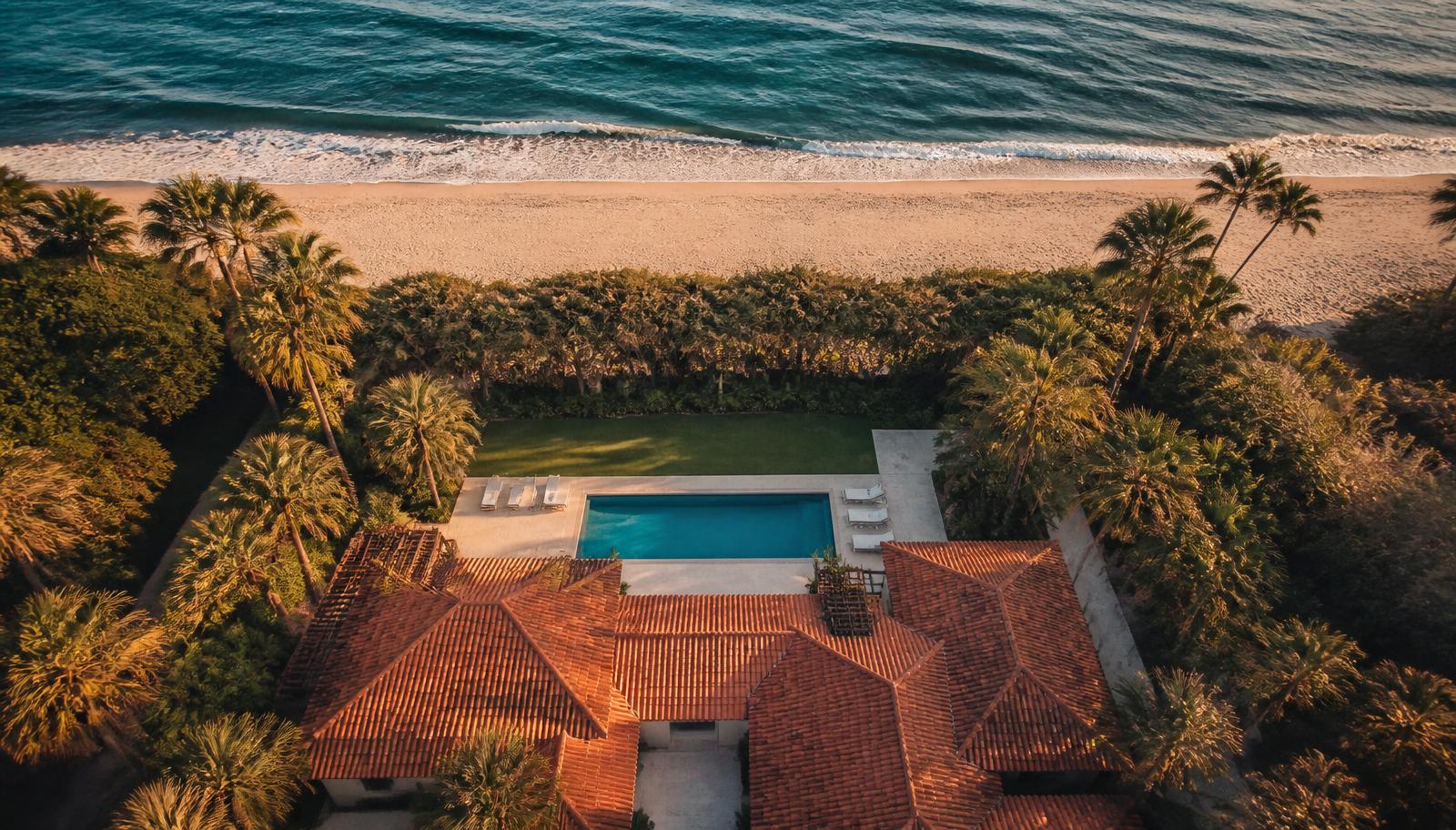
Aerial is the most underused differentiator available to owners right now, and it exists precisely to solve the problem in the section above: it shows the setting.
A drone shot answers the questions a ground-level camera cannot. How close is the water, actually? What is around the property? Is the beach a walk or a drive? Where does this sit in the landscape? Those are the questions travelers hold in their heads while they scroll, and an aerial answers all of them in one frame without a word of copy.
Use it for context, not spectacle. One or two aerials that orient the viewer beat a reel of swooping footage that tells them nothing. And keep it honest — the same rule applies to altitude as to editing. An aerial framed to hide the highway is over the line.
AI enhancement and virtual staging
The second modern layer is what AI can now do to the frames you already have: enhancement, cleanup, relighting, and virtual staging of rooms that are genuinely empty.
All of it is legitimate, and all of it sits under the same rule. Enhancement that reveals how the room really looks is fine. Virtual staging is fine when it is labelled as staging and the space and layout are real. What is not fine is staging that implies furniture the guest will arrive to find missing, or enhancement that manufactures a property that does not exist.
This is the same discipline we apply across everything we build — automate the production, keep the judgment human, and never let the machine make a promise the business has to keep. That is the thinking behind our AI approach, and it applies to a photo edit exactly as much as it applies to a booking engine.
Where each tool earns its place
| Layer | What it answers for the traveler |
|---|---|
| Interior stills | What is it like inside? Is it clean, bright, and the size I think it is? |
| Exterior stills | What does arriving feel like? Does the outside match the inside? |
| Drone / aerial | Where is this, really? How close is the water, the beach, the town? |
| Experience shots | What is my trip going to be? What do I do when I am not in the house? |
| Faces and team | Who is behind this? Is there a real person if something goes wrong? |
| Video | How does the space connect? Can I walk through it before I commit? |
07Who to learn from, and who to hire
If you want to go deeper on this than one page allows, the person I point owners toward is Tyann Marcink — a vacation rental photography expert who is known in the industry as the Queen of Guest Experience. She works at the intersection this page keeps circling: the photograph and the experience it promises are the same subject.
We have worked alongside her. Her write-up of the collaboration is on her own site — Vacation Rental Home Makeover, Episode 1 — and our side of that project, including the video, lives on the vacation rental expert makeover page.
When you are hiring, the brief matters more than the résumé. Most real estate photographers will produce technically competent room photos, which is the easy half. Ask for the other half: the experience shots, the setting, the detail that only exists in your destination. If a photographer's portfolio is entirely interiors, you will get entirely interiors.
The short checklist before your next shoot
- Declutter every surface in every room, then walk it again with fresh eyes.
- Every lamp on, every blind open, wide lens, tripod up.
- Book golden hour. Take an overcast day over a blazing one for exteriors.
- Shoot low in every room — below bed height, below counter height.
- Get the experience: the water, the street, the walk to dinner, the beach chairs.
- Get one or two aerials for orientation, not for spectacle.
- Get faces — yours and your team's.
- Place your brand cues: welcome card, screen, branded shirts.
- Edit under the rule: enhance reality, don't invent it.
- Sequence the final set as a guided tour, lead photo matching the thumbnail.
Then put the results somewhere they can work for you. Photographs delivered into an OTA listing and nowhere else are an asset you rented out to a platform. The same set on a site you own is the front page of your business — which is the argument the whole vacation rental marketing playbook is built on, and the pattern behind two decades of work on our track record.
Stop treating photography as the thing you do after the property is ready. It is the property, as far as every traveler who never books you is concerned. Shoot it bright, shoot the trip, edit it honestly — and aim for the guest who walks in and says "this is exactly what I paid for."
— Jay William, Founder, Villa Marketers
Start a strategy call See the Blue Water Cove buildKeep going
Vacation rental storytelling Pillar Content marketing for vacation rentals Pillar Social media marketing for vacation rentals Pillar Create a vacation rental brand Guide Vacation rental bedroom design Guide Build a vacation rental website GuideFrequently asked questions
How do I take good vacation rental photos?
Shoot bright, light and airy. Declutter the space ruthlessly before the camera comes out, use a wide lens so the room reads at its true size, put the camera on a tripod so the verticals stay straight, and shoot at golden hour when you can. Get low — kneeling below bed height or counter height adds depth and dynamism and lets character pieces read in the frame. Then order the finished images like a guided tour of the property, with the lead photo matching the thumbnail a traveler already clicked. If a professional photographer works in your area, hire one; that is still the best advice. If there is not one, a DSLR with a wide lens, or even a phone used strategically, plus careful editing will get you a long way.
Should I hire a professional photographer for my vacation rental?
Yes, if one is available to you. A professional brings the lens, the lighting judgment and the staging eye that most owners do not have, and the photos are the single asset every traveler evaluates before they evaluate anything else. If there is no photographer in your area, today's technology closes much of the gap: a DSLR with a wide lens gives you raw files with enough quality to edit properly, and AI-assisted editing can do work that used to require a retoucher. A phone can work too if you are strategic about light, angle and clutter.
Is it OK to edit vacation rental photos with AI?
Yes, within one rule: enhance reality, don't invent it. Removing a trash can or a parked car, brightening a room to how it actually looks to the eye, or recovering the glow you would have caught at golden hour is fair — that reveals the property honestly at its best. Faking a season the guest will not see, adding a view that is not there, or editing away an obstruction they will actually live with is over the line. That kind of edit writes a check the stay cannot cash, and it produces the bad first impression and the bad review that cost you repeat bookings.
How many photos should a vacation rental listing have?
Enough to walk a traveler through the entire property without leaving a question unanswered, and no more. Every room a guest will use, every sleeping space, the kitchen, the bathrooms, the outdoor areas, and the setting around the property — the beach, the water, the walkable street, the amenities they will actually use. Then stop. A gallery padded with near-duplicates of the same sofa from four angles buries the images that sell. Sequence matters more than volume: order the set like a guided tour so the traveler is led through the property rather than left to sort a pile.
What is the best time of day to photograph a vacation rental?
Golden hour — the hour after sunrise and the hour before sunset — is the best light for both interiors and exteriors, because it is warm, low and flattering rather than harsh and overhead. An overcast or cloudy day is also excellent for exteriors: the cloud layer acts as a giant filter and gives you even light, while bright direct midday sun bleaches surfaces and blows out the highlights. If you cannot shoot in the right light, you can adapt in editing — as long as you are recovering the way the property genuinely looks rather than inventing conditions the guest will never see.