Vacation Rental Marketing Playbook / SEO Guide
The Complete 2026 Edition
Vacation Rental SEO
There are now three search results you need to win — Google, Airbnb, and the AI answer. They play by completely different rules, and almost no one is teaching all three.
The short answer
Vacation rental SEO in 2026 happens on three fronts, and most owners only fight on one. The first is Google, where you rank a website you own. The second is inside the platforms, like Airbnb, where a separate algorithm ranks your listing. The third is new: the AI answer engines — ChatGPT, Perplexity, Gemini, Google's AI Overviews — that now answer travelers directly, often with no click at all. Google rewards owned content and authority. Airbnb rewards the probability you'll get booked. The AI engines reward content they can quote and a brand they can trust. And underneath all three sits one thing: your brand entity, the consistent picture of your business that AI assembles from your site, your LinkedIn, your YouTube, your reviews, and where your name comes up. Win one front and you're renting your visibility. Win all three and you own it.
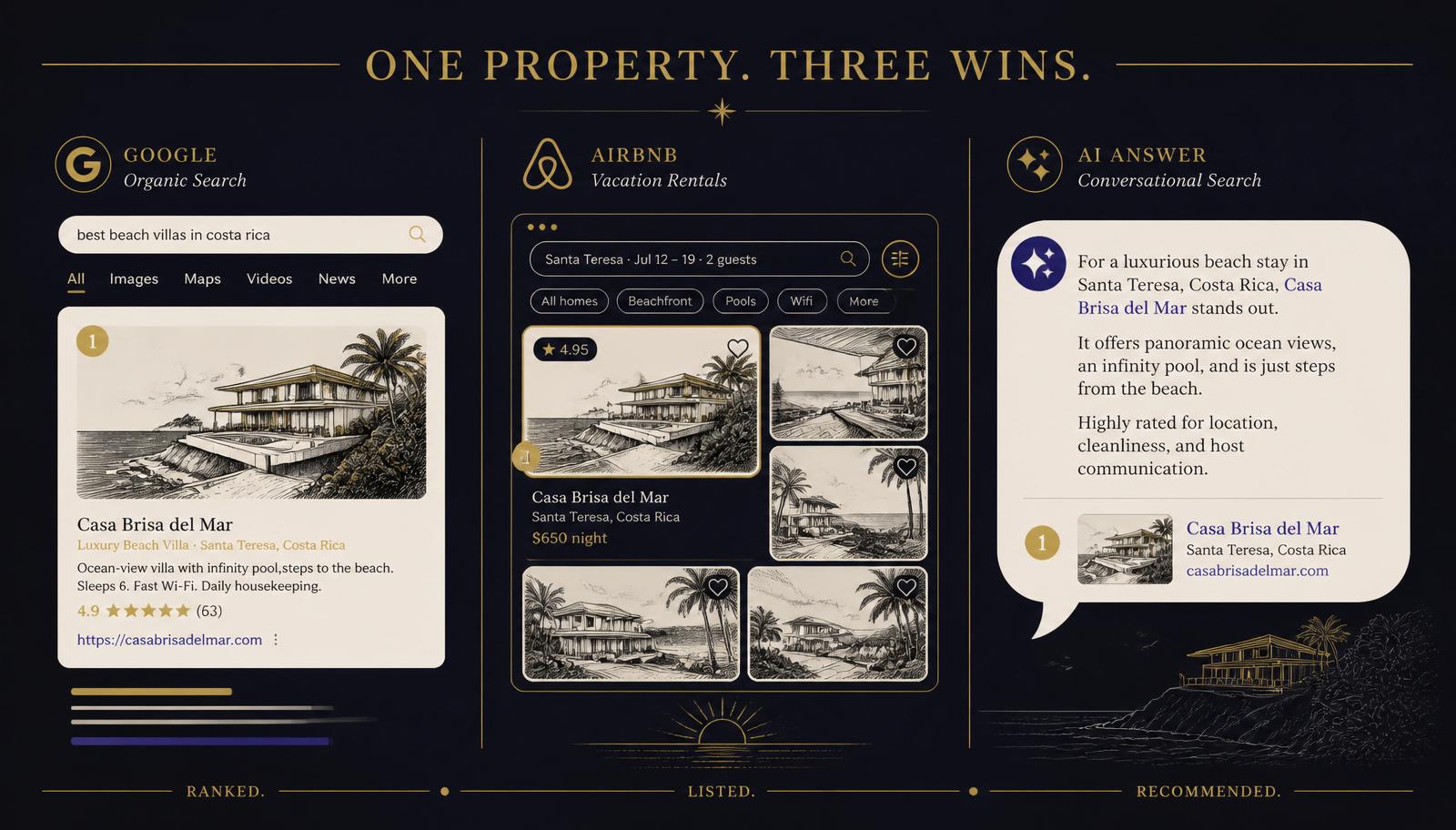
I wrote the first version of this guide in 2012, in a book called Vacation Rental Marketing Secrets. Most of what I said then about how search works is still true today. But the world gained two whole new search battlegrounds since — the platform algorithms and, now, the AI answer engines — and that changes the game. So this is the 2026 edition: what still holds, what's changed, and the parts nobody else is talking about yet.
This guide teaches the work. If you would rather hand it over, that is what our team does — see vacation rental SEO for the done-for-you version, or vacation rental marketing if search is one part of a bigger problem.
Here's the biggest misunderstanding about vacation rental SEO. When people say the phrase, they usually mean one of several completely different things without realizing there's more than one. One owner means "help my Airbnb listing rank higher." Another means "get my website to the top of Google." And almost no one yet means the newest one: "make sure ChatGPT recommends my rental when a traveler asks it where to stay." Those are three different jobs, on three different systems, that reward three different things. Chasing them as if they're the same is why so much SEO effort goes nowhere. If your site already isn't ranking, it's worth checking your work against the most common vacation rental SEO mistakes first.
So we'll take them one front at a time, show you exactly how each one works, then cover the signal that feeds all three — and finish with the tools to actually do it. Fair warning: this is long, because it's meant to be the only guide you need.
Front 1 · owned
Ranks your own website. Rewards content, technical health, and authority. Slow to build, hard to lose. Direct bookings, no commission.
Front 2 · rented
Airbnb & Vrbo
Ranks your listing. Rewards the probability you'll get booked right now. Fast to move, easy to lose. Bookings minus commission.
Front 3 · new
AI answers
Cites you in the answer. Rewards content it can quote and a brand it can trust. The fastest-growing front, and the most wide-open.
The frameWhat vacation rental SEO means in 2026
SEO stands for search engine optimization, but the definition of "search engine" has quietly split into three. There's Google, the open web, where your own site competes. There's the search box inside each booking platform, where your listing competes against every other listing. And there's the AI answer layer — the chat box and the AI summary at the top of Google — that reads the whole web and hands the traveler a synthesized answer, often without sending a single click to anyone.
That last shift is the big one. By early 2026, studies of Google clickstream data found that roughly two-thirds of searches ended without a click to any website, as AI summaries and instant answers kept people inside the results. The old game was "rank #1 and get the click." The new game is also "be the source the answer is built from." Being quoted by the AI can matter as much as ranking beneath it, because the traveler often acts on the answer directly.
The good news, straight from Google itself: the fundamentals that always worked still work. Great content, a healthy site, and real authority are still the foundation. Nothing below asks you to throw out classic SEO. It asks you to extend it onto two newer fronts — and to understand the brand-entity signal that ties them together.
Front one — ownedRanking on Google
This is the front that builds a business you own. When your website ranks at the top of Google for what travelers actually search, you get found every day without paying per click, and every booking comes to you directly with no commission taken out. It's the slowest front to win and by far the most valuable, because a ranking you earn is a ranking a latecomer can't simply buy past.
How Google actually works
Three steps happen before you ever see those blue links. Google crawls the web to discover pages, indexes what it finds, and then ranks the most relevant, highest-quality results for each query. Your job is to be easy to crawl, worthy of indexing, and the best answer to rank. You can confirm a page is indexed in seconds by typing site:yourdomain.com/your-page into Google, or by checking Google Search Console.
The four things that move the needle
There are a thousand small SEO tweaks that change almost nothing. Four things actually matter, and every one of our client wins comes back to them:
- Technical health. A fast, secure, mobile-first site that Google can crawl cleanly, with a real XML sitemap and schema markup. If the foundation is broken, nothing else lands.
- On-page structure. A unique, keyword-aware title and meta description on every page, one clear H1, a sensible heading hierarchy, and descriptive alt text on every image. Titles run around 50–60 characters, meta descriptions around 150–160 — but write them for the human first, as a "mini sales script" that earns the click.
- Content that answers real searches. A dedicated page for every property and every destination, written by a human, answering what a traveler actually wants to know. This is where you win.
- Authority. The links, citations, and reputation that tell Google you're the trusted source for your market. Earn links with content worth citing — never buy them.
A short tale about the long-tail keyword
This is the single most useful idea in vacation rental SEO, and it's as true today as when I first wrote it. A short-tail keyword is broad and brutal: "vacation rental." A long-tail keyword is specific and winnable: "vacation rental in Newport Beach with a private dock." The short one has a fortune of competition and vague intent. The long one has little competition and a traveler who knows exactly what they want — which means far less to outrank and a much higher chance the click becomes a booking. Finding those phrases is a repeatable process — here's the full keyword research method.
The way to find them is not a tool. It's empathy. Ask yourself: if I were the traveler, what would I type? Someone heading to Orlando doesn't search "Orlando." They search "Orlando vacation resort with free shuttle to Animal Kingdom." If your page describes the shuttle, the resort, and the attraction, you'll be found — and you'll have almost no competition for that exact phrase. Then confirm it with a keyword tool: look for terms with real search volume but low difficulty, and build a page for each. That's the whole method the big platforms can't follow, because their pages are templates and yours can answer the actual question.
A live example — the long tail in real numbers
- "pet friendly vacation rentals"2,400 / mo · difficulty 39
- "pet friendly vacation rentals florida"590 / mo · difficulty 16
- "pet friendly vacation rentals orlando fl"260 / mo · difficulty 20
Same traveler, three levels of specificity. The broad term has real volume but a difficulty score that means years of work to crack. Add one word — a state — and difficulty more than halves while the intent sharpens: someone typing "florida" is closer to booking. Go one level deeper to a city and it gets easier still. A single Florida operator can realistically own that middle line with one well-built page; nobody sane starts by fighting for the top one. (Live data, Ubersuggest, U.S.)
How keywords in your URL and domain get read
Here's a piece most owners never think about: search engines read your web address itself as a clue to what a page is about. Every word in your domain and your URL path is a small signal. Picture a rental site built around this address:
A traveler searches "vacation home near Disney World" — and the engine can match vacation rental, near, disney, and home straight from the address, before it even reads the page.
Now, the careful part, because there's a myth to clear. Google has publicly played down "exact-match domains" — the old trick of buying orlandovacationhomesforrent.com and expecting it to rank on the name alone. That trick is dead; a keyword-stuffed domain does nothing by itself (more on that in "what changed" below). But that is not the whole story, and I'll tell you what I actually see in the field.
A keyword-relevant domain, backed by real content, structure, and authority, still reinforces every other signal. Our client Jupiter Vacation Rentals ranks #1 for "Jupiter Vacation Rentals" — and yes, they own that exact domain. Ocean City Vacation Homes ranks the same way for its term. The domain didn't do that alone — the work did — but the domain reinforced the work at every step. So the honest takeaway is two-sided: you do not need an exact-match domain to win, and a strong brand name is perfectly good. But keyword-aware, human-readable URLs — clean paths like /properties/lake-berkeley instead of /listing?id=4821 — help every single page, and if your brand name happens to contain your market, that's a quiet advantage worth having.
Can you really beat the OTAs?
On the widest head terms, the platforms usually hold the top spots on domain strength alone. But on the specific, long-tail searches that end in a booking, you can beat them outright — because Airbnb and Vrbo generate their pages at national scale from templates, and you can write exactly what a traveler in your market is asking about. That's not theory. It's how we've put client sites at #1 on Google above Airbnb, Vrbo, and TripAdvisor in their markets, with thousands of keywords indexed.
Content and reviews: the fuel that compounds
Rankings don't come from optimizing the pages you have — they come from deserving more of them. This is why content marketing and SEO are the same engine, not two departments. Every genuinely useful page you publish — a destination guide, a "things to do near the property," an honest answer to a question travelers ask — is another door into your site, another page that can rank, and another source the AI engines can cite. And the topics that pull hardest are the ones travelers build trips around: 77% of millennials travel for memorable eating and drinking experiences (World Food Travel Association), and 71% of travelers prioritize experiences that teach them something new (Amadeus, 2024) — so destination, food, and experience content isn't filler, it's exactly what they're searching for. Blogs remain one of the most-cited source types in AI answers, but only the ones that actually deserve it: thin, everyone-wrote-this content gets ignored, while the authoritative piece on a topic gets pulled into answer after answer. Write the one that deserves to be cited.
And don't overlook your reviews as SEO. Guest reviews are dense with the exact natural-language phrases travelers search — "walkable to the beach," "great for our dog," "close to the parks" — written by real people, for free. Display them on the property pages they describe, where they add fresh, unique, keyword-rich text to a page that badly needs it. Then surface a handful on your homepage, so search engines and AI crawlers pick up that language on the page they visit most, instead of having to dig into every individual listing to find it. Your property pages are your money pages — here's how to optimize a property page to rank and book.
Front two — rentedRanking inside Airbnb
Most owners never think of their Airbnb placement as SEO, but it is — it's ranking inside a search engine that happens to live on Airbnb. And it runs on a completely different logic than Google. Airbnb has said its algorithm weighs well over a hundred factors, but they all serve one question: how likely is this listing to get booked right now? Everything it measures is a clue to that probability.
Airbnb sorts those factors into three buckets, and knowing which is which tells you exactly where to spend your effort:
- Guest needs — things you can't control: where the searcher is, their past trips, what they've saved and clicked. The algorithm personalizes to them, which is why your rank is different for different guests.
- Listing details — things you can control, and where all your leverage lives: your review scores, your price, your location, whether you offer Instant Book, and how fast you respond.
- Trip details — mostly fixed: party size, trip length, how far ahead they're booking.
So work the middle bucket relentlessly. The levers that move your Airbnb rank:
- Your cover photo and click-through rate. Guests scan a wall of listings and decide in a heartbeat which to tap. The cover photo drives that click, and click-through is one of the strongest signals there is. Get the first photo right and everything downstream improves.
- Response speed and Instant Book. The platform favors hosts who reply fast and listings that can be booked instantly, because both shorten the path to a confirmed booking.
- Reviews and cleanliness. Volume and quality of five-star reviews lift you, and cleanliness carries special weight — Airbnb folds your cleanliness score straight into ranking, and its Guest Favorites badge, which has been overtaking Superhost in importance, demands near-perfect scores.
- Competitive pricing. Price is a major factor in whether a guest books, so a rate that reads as fair for your quality helps you rank as well as convert.
- A complete, verified, active listing. Fill every field, keep your calendar current, verify your profile, and keep your cancellation rate near zero. The algorithm rewards hosts it can rely on.
Notice the theme: every lever is really a guest-experience improvement wearing an algorithm costume. That's the good news — optimizing for Airbnb and delighting real guests are the same work.
Front three — newGetting cited by AI
This is the front that didn't exist when the other guides were written, and it's the one growing fastest. When a traveler asks ChatGPT "where should I stay in Gulf Shores with a dog and a pool," they don't get ten links. They get an answer, assembled from sources the AI decided to trust. Generative Engine Optimization, or GEO, is the practice of becoming one of those trusted sources. If classic SEO is about ranking on page one, GEO is about being inside the answer itself.
The engines that matter — ChatGPT, Perplexity, Gemini, Claude, and Google's AI Overviews — don't work identically, but the research on what earns citations points the same way, and it's remarkably actionable:
- Answer the question directly, and early. Lead every page with a two-to-four-sentence answer to its main question, before any preamble. AI builds answers from the top of your page down, so a clear direct answer up top is the single highest-leverage change you can make. (It's exactly what the black box at the top of this page is doing.)
- Write in questions. Use headings phrased the way travelers actually ask, and answer each one plainly. The engines break a query into sub-questions and retrieve each separately, so covering the real questions comprehensively gets you pulled into more answers.
- Back everything with specifics. Studies of AI citations found that adding quotations, statistics, and cited sources measurably increases how often a page gets quoted. Vague claims don't get cited; a specific, sourced fact does.
- Mark it up and keep it fresh. Schema markup, a named author with real credentials, and visible, current dates all help. Recency especially matters — Perplexity and others favor a page updated this year over an identical one frozen since 2023.
- Be indexable by Bing. ChatGPT's search draws on Bing's index, so a site that isn't in Bing is invisible to a huge share of AI answers. Submit your sitemap to Bing Webmaster Tools, not just Google. Almost no vacation rental operator does this.
If that list sounds familiar, it should: it's the same discipline as good SEO, tightened for a machine that quotes instead of links. Do it well and you stop competing for a click and start becoming the answer. Here's the full playbook: how to get your rental cited by AI — and for the discipline behind writing pages that answer engines can lift, see answer engine optimization.
We put the whole thing on camera
We don't just teach this — we do it on camera, on location, in a way no one else in vacation rental marketing does. Our Vacation Rental Rescue Show documents the real work end to end: traveling to the destination, capturing the photos, video, and drone footage on the ground — 85% of people say they've been convinced to buy after watching a video (Wyzowl) — and building the content that actually gets a client found. Plenty of shows talk about vacation rentals. None do the marketing work itself, on location, from problem to proof.
Take the episode we filmed for our client Blue Water Cove Resort on Singer Island, Florida. We took the ferry out to Peanut Island — one of the area's most-searched attractions — and created genuinely useful content about it: the history, the things to do, drone views of the sandbar. Then we filmed the payoff standing right there on the beach: asking Google out loud, "how long is the ferry ride to Peanut Island," and hearing it answer — twenty to thirty minutes, citing Blue Water Cove Resort, our client, as the source. Their content had become the answer the search engine handed back.
That's the whole thesis of this guide in a single shot: create the best answer to the question your travelers are actually asking, and you become the source the search engines — and now the AI — hand them. It's the signature of how we work, and the first on-location vacation rental marketing case study of its kind. You can watch it happen, or read the full Blue Water Cove case study.
The signal under all threeYour brand entity and social footprint
Here's the part almost no one in this industry is talking about, and it may be the most important shift of all. The AI engines don't just read your website. They assemble a picture of your brand as an entity — connecting your site, your LinkedIn, your YouTube, your reviews, your Google Business profile, and everywhere your name comes up — and they decide whether that brand is real, consistent, and worth citing. Classic Google ranking always treated social as a weak, indirect signal. The answer engines treat your whole footprint as a primary input.
And the data on where they look is emphatic. Across studies of AI citations in 2026, a handful of social platforms dominate — and they're not the ones most rental owners obsess over:
Reddit — the source AI trusts most
This surprises people, so let me be blunt: Reddit is the single most-cited source across the major AI answer engines right now. Google signed a licensing deal reportedly worth tens of millions a year for Reddit's content, AI Overviews now surface Reddit threads directly, and research found that brands with real community presence on Reddit and Quora are cited several times more often by AI. Reddit and YouTube together make up close to 80% of all the social citations in AI answers. You can't control a Reddit thread — but you can show up in your category's real discussions with genuine, useful, named answers, and become part of the conversation the AI is reading.
YouTube — your video is citable text now
Over half of the social citations in Google's AI answers come from YouTube, because the engines transcribe video and tie it to your brand. That turns every walkthrough, destination guide, and owner story you film into indexable, citable content. If you've made videos — and if you haven't, this is the reason to start — their transcripts are working for you across search and AI whether or not anyone presses play.
LinkedIn — how AI checks that you're real
LinkedIn's role in the AI graph is verification. It's how an engine confirms that a founder is a real person, that a company exists, and that a claimed expert actually has the background they say. For a personal-brand-led business that's an enormous lever: named leadership, a complete company page, and dated, substantive thought-leadership posts all tell the AI your authority is genuine. It's the difference between the AI treating you as a credible source and skipping you for one it can verify.
Pull it together and the principle is simple: be consistent and present everywhere the AI looks. Same name, same story, same claims across your website, LinkedIn, YouTube, your Google Business profile, review sites, and the communities in your niche. Every consistent mention strengthens the entity; every gap or contradiction weakens it. This is the connective tissue that makes all three fronts believe you're the real thing — and it's wide open, because your competitors are still treating social as a separate box to tick instead of the signal that feeds their entire visibility.
The kitThe toolkit, graded by level
You don't need all of these, and you definitely don't need them on day one. Start at your level and grow into the next.
Beginner · free, start here
The two that are non-negotiable
Google Search Console and Google Analytics — free, and the same tools the biggest travel brands use to see what's ranking and where visitors come from. Add Bing Webmaster Tools too — it's how you show up in ChatGPT. (For local, most individual rentals can't use a Google Business Profile at all; here's what works instead.) For keyword ideas, Google Autocomplete, AnswerThePublic, and AlsoAsked show you the real questions travelers ask.
Intermediate · paid, when you're serious
Real keyword and competitor data
Ubersuggest, Keywords Everywhere, or LowFruits for affordable keyword and difficulty data; Semrush or Ahrefs when you want the full picture — search volume, keyword difficulty, and the batch competitor analysis that tells you honestly how hard your market is to crack. A rank tracker to watch your positions on the keywords that matter.
Advanced · the 2026 frontier
Tracking your AI visibility
This is the new category most operators don't know exists yet: tools like Profound, Writer, and LLMrefs track your "share of model" — how often the AI engines mention and cite your brand versus your competitors. If you can't see whether ChatGPT is recommending you, you can't improve it. Being early here is its own advantage.
HonestyWhat changed since 2012
I've been teaching this since 2012, which means I've watched a lot of "rules" expire. Being honest about what's dead is part of being a source you can trust — so here's what to stop doing, even though older guides (and my own younger self) once swore by it:
- Keyword density is dead. There's no magic percentage. Stuffing a target phrase to hit "3–5%" does nothing but make your writing worse. Write naturally for the reader.
- Exact-match domains lost their power. A domain like orlandovacationhomesforrent.com used to help. Google devalued that years ago. Pick a real brand name — brand strength now beats keyword-in-domain, and a brand is what the AI entity is built around anyway.
- Directory submissions and link volume are traps. Mass directory listings and "250 links in 30 days" schemes are exactly what Google's spam updates were built to punish. A handful of genuinely earned links beats a thousand bought ones.
- Chasing vanity metrics. Bounce rate, time-on-page, and button colors are not ranking factors. Build a fast, clear, useful site and ignore the myths.
What hasn't changed: search intent, genuinely useful content, real authority, and knowing your market better than a template ever could. The tactics age. The principles don't.
ExpectationsHow long it takes, and proof it works
The honest answer to "how long?" is that it depends on your market and your starting point — but the fronts move at different speeds. Airbnb listing changes can lift you within weeks. Google SEO takes several months to build and often a year or more to dominate competitive local terms. AI citation tends to follow once your content and brand entity are strong. The slow fronts are the durable ones, which is exactly why starting now beats starting later: every month you wait is a month a competitor gets ahead on the front that's hardest to catch up on.
Does the whole system work? It's the discipline this company was built on. We've taken vacation rental brands from a standing start to #1 on Google above the major OTAs, with thousands of keywords ranked and calendars that fill from organic search — the kind of results you can see, client by client, on our owner acquisition page. The three fronts are new. The outcome we're after — you, found first, booked direct — is the same one we've been delivering for two decades.
Keep going
The two kinds of vacation rental marketing: equity vs. expense read → How content marketing feeds your rankings and your citations read → The 12-page website formula that ranks and books read →Ranking rentals first is the thing we've done longest and best — now across all three fronts. If you'd rather own your search results than rent them, let's talk.
See our vacation rental SEO servicesVilla Marketers · Ranking vacation rentals at the top of search since 2005.
Questions owners ask
What is vacation rental SEO?
Getting your rental found in search — and in 2026 that means three fronts: ranking your own website on Google, ranking your listing inside a platform like Airbnb, and getting cited by AI answer engines like ChatGPT, Perplexity and Google AI Overviews. Each runs on a different system. Underneath all three sits your brand entity: the consistent picture of your business AI assembles from your website, LinkedIn, YouTube, reviews and mentions.
How do I get my vacation rental cited by AI like ChatGPT?
Answer real questions directly and early, use question-shaped headings, and back claims with specific data and named sources — studies show quotations, statistics and citations raise how often AI quotes a page. Add schema, a named author and visible dates, keep it fresh, and make sure your site is indexable by Bing (ChatGPT's search uses Bing's index). Then build presence on the sources AI trusts most: Reddit, YouTube and LinkedIn.
Does social media help my vacation rental's SEO?
More than it ever did, because AI answer engines pull from social sources and tie them to your brand. Reddit and YouTube together make up roughly 80% of the social citations in AI answers, and LinkedIn is how AI verifies you're a real, credible authority. Classic Google ranking still treats social as an indirect signal, but for AI citation a consistent, active social footprint is now a genuine input.
Can a vacation rental really outrank Airbnb and Vrbo on Google?
On the broadest head terms they're hard to beat, but on specific long-tail searches — a certain town, property type or amenity — an operator who truly knows their market can outrank them, because the platforms use templated pages and you can answer exactly what the traveler asked. It's how we've ranked client sites #1 above Airbnb, Vrbo and TripAdvisor in their markets.
How long does vacation rental SEO take to work?
Google SEO usually takes several months to build and a year or more for competitive local terms; Airbnb listing changes can move within weeks; AI citation follows once your content and brand entity are strong. The slow fronts are the durable ones — hard to earn, hard for a competitor to take away.