Vacation Rental Marketing Playbook / Airbnb Fees 2026
Platform Economics · Living Analysis
Airbnb Didn't Raise Its Fee. It Made It Invisible — and Made You the Bad Guy.
What the 15.5% host-only fee really costs — and the move nobody's talking about.
The fee didn't just go up. It went invisible. That is the part of this story the how-to guides keep missing, and it is the part that will cost you the most.
The direct answer
Airbnb has moved to a single host-only service fee of 15.5% of the booking subtotal (16% in Brazil and Mexico), deducted from the host's payout. The guest no longer sees a separate Airbnb service fee — they see one all-in price. The old split model, where the host paid roughly 3% and the guest paid a visible 14% to 16% at checkout, is being retired listing by listing through 2026.
The 15.5% is charged on the full subtotal — nightly rate plus cleaning fee, pet fee and extra-guest fee. Not taxes, not security deposits.
But the number is the boring part. The real story is what invisibility does. A fee the guest can see is a fee the guest blames the platform for. A fee baked into your price is a fee the guest blames you for — and you don't even keep it.
Just want to know how much host fees cost you? This page is the analysis of the fee change. For the evergreen breakdown of what the fees are, how Airbnb, Vrbo and Booking.com compare, and a calculator that runs your own revenue and your own editable rate, read Airbnb host fees — run your numbers in the calculator.
Airbnb didn't raise its fee. It made it disappear — and a fee your guest can't see is a fee your guest blames you for. That is the whole story in one sentence. Airbnb did not announce a price increase; it announced a simplification. A simplification is much harder to be angry about, and the anger has to land somewhere. It lands on your nightly rate.
I have been marketing vacation rentals since 2005, which means I have watched every major platform run the same play at least once: arrive as a distribution partner, become the demand, then start pricing like it. This one is different only in its elegance. I wrote about it in August 2025, two months before the first wave went live, and the trade press picked it up. What follows is the complete version: the verified mechanics, the money, the European VAT trap, the market data that kills the lazy "guests are fleeing" take — and then my own read on where this goes, clearly labelled as analysis so you can weigh it as an argument rather than a fact.
In this guide
- The facts: what actually changed
- What the fee applies to (including your cleaning fee)
- The rollout timeline — when your listing moves
- The markup math: 15.5% or 18.34%?
- Europe: why 15.5% isn't 15.5%
- The blind spot: an invisible fee transfers the blame
- The market pulse: is this driving guests away?
- The convergence — and what I think comes next
- What smart hosts are doing right now
- What to watch (and we'll update this)
- Frequently asked questions
01The facts: what actually changed
Two models, one replacing the other.
| Old split model | New host-only model | |
|---|---|---|
| Host pays | Around 3% of the booking subtotal | 15.5% of the booking subtotal (16% in Brazil and Mexico) |
| Guest pays | A visible service fee, roughly 14–16%, added at checkout | No separate service fee — one all-in price |
| Where it shows | A line item on the guest's bill | A deduction from the host's payout |
| Who gets blamed | Airbnb | Whoever set the price. That's you. |
This is confirmed by Airbnb's own host guidance and reported consistently across the operator ecosystem — Hostfully, Houst, Hostaway, Truvi, Futurestay, TabiVista and PriceLabs all describe the same structure. There is no disagreement about the mechanics. The disagreement is only about what it means.
A few edge cases are worth knowing before you model anything. Long stays of 28 nights or more are frequently charged at a lower rate. Listings on the Super Strict cancellation policies can be charged around 17.5% rather than 15.5%. And in the EU, VAT sits on top of the fee — which is a large enough problem that it gets its own section below.
If you're a traveler reading this
Short version: yes, Airbnb still charges a fee — you just cannot see it any more. It used to be added at checkout as its own "service fee" line, which is why the price jumped between the search results and the final screen. Under the new model that cost comes out of the host's payout instead: 15.5% of everything you are charged for the stay, cleaning fee included. Nothing was removed from your total. It was moved out of a labelled line and baked into the nightly rate you see up front. One clean number. It feels more transparent, and in one sense it is — but it also means you can no longer tell how much of what you are paying is the stay and how much is the platform's commission.
So if a place looks more expensive than it did last year, this is a big part of why. Hosts are now absorbing that 15.5% cut — 16% in Brazil and Mexico, and effectively somewhere around 18.4% to 19.1% for many European hosts once VAT is added on top and cannot be reclaimed. Most of them have raised their listed prices to cover it, because very few small operators have that kind of margin sitting spare. The host is not pocketing the increase. They are covering a charge that used to sit on your side of the receipt with the platform's name on it.
Which leads to the part worth knowing before you book: the exact same property is often cheaper on the host's own website. There is no 15.5% platform commission on a direct booking — the host pays roughly 2% to 3% in card processing and keeps the rest, so a lot of them will pass part of that saving on to you, or add something (a late checkout, a discount on longer stays, a welcome basket) to win the booking directly. The fee did not disappear; it went invisible, and invisible means you cannot shop around it while you are still inside the app. If you find a place you like, it costs you thirty seconds to search the property's name, or the host's, and see whether they take bookings themselves.
To be fair about it: booking direct usually means dealing with a real person rather than a support queue, more flexibility on check-in times and changes, and your money going to the operator instead of a platform. It also means trading Airbnb's guest protections and dispute process for the host's own reputation and word. Those protections are real on paper and sometimes pay out, but they are widely reported as inconsistent: claims get denied, and "not as described" stays sometimes go unrefunded even when guests leave immediately. The honest tradeoff is between a human operator with a direct stake in making it right and keeping their reputation, and a platform claims process that may or may not come through. It is a real choice, not a trick — just one you can only weigh properly if you know the fee is in there at all.
02What the fee applies to — including your cleaning fee
This is the detail most hosts miss, and it is the one that changes your numbers most.
The 15.5% is not charged on your nightly rate. It is charged on the booking subtotal: the nightly rate plus every charge you set. Cleaning fee. Pet fee. Extra-guest fee. Any host-added charge. It is not charged on taxes, and it is not charged on security deposits.
The worked example
$115 night + $50 cleaning = $165 subtotal
Airbnb's fee is 15.5% of the full $165 — roughly $25.58 — not 15.5% of the $115 room rate. This example is the one used in operator guidance from Hostaway and Houst, and it is the clearest way to see the mechanic.
What hosts assume
The commission comes off the room revenue, so the cleaning fee passes through to the cleaner untouched.
What actually happens
The commission comes off everything you charge. Your cleaning fee is now a commissionable line item.
Airbnb now takes a cut of your cleaning fee — a $100 cleaning fee costs you an extra $15.50. That is the sentence to sit with. If you run a large home with a genuinely expensive turnover, this single detail can be worth more to your annual P&L than the headline rate change, because it is a cost you were treating as a pass-through and it is no longer one.
03The rollout timeline — when your listing moves
Not everyone moved at once, which is why the industry conversation has felt so disjointed: half the market has been living under the new fee for months while the other half is still on the old one and does not know a change is coming.
| Wave | Who | When |
|---|---|---|
| First | Hosts connected through property management software | From 27 October 2025 (some from August 2025), in waves through April 2026 |
| Second | Independent, non-software-connected hosts | Country by country across 2026 |
| Final deadlines | Non-EU markets / EU, EEA and Switzerland | 15 September 2026 / 13 October 2026 |
The tell most hosts miss
Using a pricing tool does not make you "connected." A host running PriceLabs but no PMS still counts as non-connected and is scheduled in a later wave. If you assumed your tooling put you in the first group, check — you may have months of runway you did not know you had, or a change landing sooner than you planned for.
04The markup math: 15.5% or 18.34%?
Two different questions, two different answers, and conflating them is how people end up short.
- To restore your old payout — what you were netting under the split model, where you paid about 3% — raise your prices by roughly 15.5%.
- To net your full advertised rate after the fee is taken, divide by one minus the fee: 1 ÷ (1 − 0.155) = ×1.1834. An 18.34% increase. Marking up by 15.5% and expecting to net your old rate is the arithmetic error to avoid — a 15.5% increase does not offset a 15.5% deduction.
PriceLabs, TabiVista, Hostaway and Rental Scale-Up all land on the same divisor. There is no controversy in the math; there is only carelessness in the application. Three rules for applying it:
- Mark up every component, not just the nightly rate. The fee is charged on your cleaning, pet and extra-guest fees too, so those need the same ×1.1834 or you are quietly eating the commission on each one. Airbnb's own price tool applies the adjustment across components deliberately — follow the same logic in your own numbers.
- Change it in exactly one place. If you run a PMS, make the change there, not in Airbnb's tool, or the next sync overwrites you and you spend a week wondering why your rates reverted.
- Test it. Open an incognito window, search your own listing as a guest, and read the total. That is the number your guest is judging you on, and it is the only place the whole chain of settings shows its real output.
05Europe: why 15.5% isn't 15.5%
In the EU, VAT is applied on top of Airbnb's service fee. Whether that matters depends entirely on your registration status, and the gap between the two cases is large.
Two European hosts, one fee
VAT-registered
You recover the VAT charged on the service fee. Your effective cost stays at about 15.5%. Annoying paperwork, no real economic loss.
Not VAT-registered
You cannot recover it. The VAT becomes a final cost, pushing your effective fee to roughly 18.4%–19.1% depending on your country's VAT rate. That describes most individual European hosts.
The country-by-country detail on this has been worked through carefully by PriceLabs' Rental Scale-Up and in European host reporting, and I would send you to them for your specific market rather than reproduce their table here. What I will say plainly is the range: a non-registered EU host is not paying 15.5%. They are paying something closer to 19%, and that is the number that belongs in their model.
You can see the mechanic in the wild in Airbnb's own community forums, where hosts have posted booking breakdowns with the fee line labelled "Host service fee (3.0% + VAT)" under the old model — VAT has always ridden on top of the service fee; it simply mattered far less when the fee it rode on was 3% instead of 15.5%. That is the whole problem in one line: the same VAT rule applied to a fee five times larger.
Don't over-correct
Registering for VAT purely to reclaim the VAT on Airbnb's fee usually backfires, because registration brings VAT obligations on your own rental income. Talk to an accountant in your country before treating registration as a fix.
06The blind spot: an invisible fee transfers the blame
AnalysisEverything in this section is my argument, not reported fact. The mechanics above are verified; the reasoning below is mine, and you should read it as a case being made rather than a thing being reported.
Here is what I think everybody is getting wrong. The industry has covered this story as a cost story: the fee went from 3% to 15.5%, here is your spreadsheet. That is real, and you should fix your spreadsheet. But the cost is the smaller half.
The fee did not just rise. It disappeared. And a fee nobody can see does something a fee everybody can see never did: it moves the blame.
Under the old model, a guest reached checkout, saw a nightly rate they liked, then watched a service fee land on top of it. Whatever irritation that produced attached to Airbnb. The host was the person offering the good rate; the platform was the one adding to it. That was a genuinely valuable position to be in, and almost nobody valued it.
Now the fee is inside your price. When a guest thinks "this got expensive," there is only one name on the listing to attach that thought to, and it is yours. Airbnb keeps the 15.5%. You keep the reputation cost.
Repricing correctly makes the blame problem worse, not better.
That is the kicker, and it is the part I have not seen anyone else say. The 18.34% markup is the correct accounting answer — every guide recommends it, including this one. But executing it means raising your visible price to cover a fee your guest can no longer see. You fix your margin by making the very thing the guest blames you for larger. The accounting fix and the reputation problem point in opposite directions, and there is no version of the arithmetic that resolves it. You can protect your payout or you can protect your price perception on that platform. Not both. And as I will show later, that transferred blame does something worse than dent your reputation — it quietly hands Airbnb the reason to erase you.
And notice the timing. The FTC's Junk Fees Rule — finalised in December 2024, in effect since May 2025 — targets short-term lodging and live-event tickets, and it was built to kill drip pricing: a low headline rate with mandatory fees revealed late in checkout. The old Airbnb model was almost a diagram of the thing the rule was written to catch. Nightly rate up front, a labelled "service fee" dripping on at the final screen. But read what the rule actually governs. It regulates how prices are displayed, not what may be charged. It caps nothing and bans no fee. It requires that the all-in total be shown prominently up front; you may still itemise, as long as the total is the most prominent number and mandatory fees are disclosed.
Here is the move, and it is a clean one. A disclosure rule can force you to show a fee. It cannot force you to keep charging the guest a separate fee at all. Airbnb's host-only model does not comply by disclosing the service fee more prominently — it complies by making the guest-facing service fee cease to exist. There is no service-fee line left to disclose, because the 15.5% now lives inside the host's nightly price. It is not "a fee" any more; it is "the price the host set." So the rule has nothing to bite on: its entire subject, a disclosable mandatory guest fee, was dissolved into the base price. Under the old model even a perfectly compliant checkout still showed the guest a labelled service fee, so the platform's cut stayed visible. Under the new one there is no line to show, and the visibility the rule was designed to force is precisely what got removed. On paper this is arguably more compliant — one clean all-in number, nothing dripping late — while defeating the entire purpose of it. You cannot be cited for hiding a fee you no longer charge. Nothing was evaded; the regulation was simply made moot, because its subject no longer exists in a discloseable form. My line from last August still holds: you can't regulate what consumers can't see.
07What I wrote in August 2025, before the rollout
I posted the following on LinkedIn on 26 August 2025 — two months before the first wave went live on 27 October. It is the post the trade press picked up. I am reproducing the lines verbatim rather than paraphrasing them, because the point of including it is the timestamp.
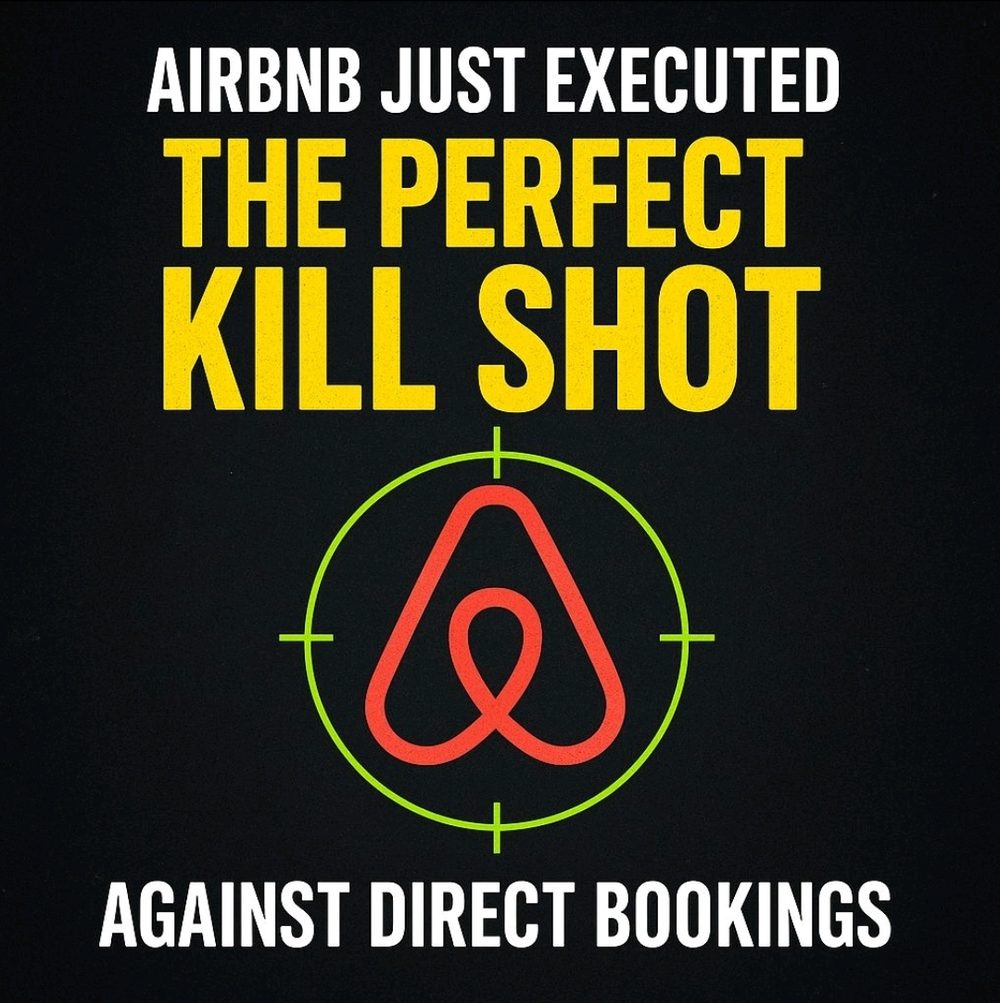
Jay William · LinkedIn · 26 August 2025
Airbnb Just Executed the Perfect Kill Shot Against Direct Bookings.
- I've been warning this was inevitable for years. The only surprise is how long it took them.
- Regulators have targeted 'junk fees.' Airbnb's solution? Make their fees invisible. You can't regulate what consumers can't see.
- Before: guests blamed Airbnb. Now: they'll assume you are charging more. Airbnb keeps 15.5%. You take the heat.
- This isn't just a fee change. It's the opening move in extracting host profitability.
Posted 26 August 2025, two months before the 27 October rollout began. Read the original post on LinkedIn →
Cited in the trade press
The analysis was picked up by the travel trade press, which quoted me on this fee change as co-founder of Knokx and founder of Villa Marketers:
PhocusWire — Airbnb changes service fee, OTAs and hotels
WebInTravel — Airbnb seems set up for hotel expansion, competition with OTAs
08The market pulse: is this driving guests away?
The comfortable take is that guests are fleeing and the platform is in trouble. The data says otherwise, and the truth is more uncomfortable than the comfortable take.
From Airbnb's own Q1 2026 shareholder letter: revenue up 18% to $2.7 billion, gross booking value up 19% to $29.2 billion, nights and seats booked up 9% to 156.2 million, net income of $160 million. The company described "momentum across the business." There is no downtrend to point at.
But read those two growth numbers next to each other. Gross booking value up 19%; nights up 9%. Roughly ten points of the growth is not more people staying — it is higher prices per stay. Analysts at PriceLabs, AirROI and AirDNA have made the same observation: the gap is rate, not volume. Average daily rate rose 9% (4% excluding currency effects). PriceLabs forecasts US occupancy flat to slightly down in 2026 — and importantly, not because demand is weak, but because supply is growing faster than demand.
Meanwhile the category itself is expanding. Mordor Intelligence puts the US short-term vacation rental market at roughly $71.7 billion in 2026, growing at about 7.2% a year. Grand View Research has the global market moving from roughly $149 billion in 2025 toward $362 billion by 2033, an 11.8% compound rate. Travelers are choosing private-home stays over hotels more often, and they are staying longer — the average US stay has moved from 4.0 to 4.42 nights.
Analysis — Jay's read
A growing market with a rising platform cut is a worse trap than a shrinking one
In a downturn, everyone pays attention. Costs get audited, contracts get renegotiated, nobody accepts a bigger cut quietly. In a boom, the top-line number goes up, everyone feels fine, and the share you hand to the platform slides upward without anyone flinching. The squeeze happens under cover of good news.
So the question I would put to any operator reading this: if the market is growing this fast, why hand a growing share of it to a platform that is simultaneously raising your costs and hiding those costs from your guests? Growth is exactly when you have the leverage and the cash flow to build the channel you own.
09The convergence — and what I think comes next
In August 2025 I argued this fee change blurred the line between hotels and vacation rentals: same all-in pricing display, same commission logic, same competitive set. That was a prediction at the time.
Airbnb's Q1 2026 disclosures point the same direction. Hotels are now growing at more than twice the rate of the rest of the business, with pilot programs running in New York, Los Angeles, San Francisco and Madrid, and management describing hotels as a much bigger strategic priority. I made the argument; the platform's own earnings commentary then confirmed the direction of travel.
The prediction: brand-neutral listings — in two tiers
Prediction — not a reported Airbnb planWhat follows is my reasoned forecast with the mechanism spelled out. Airbnb has not announced this. Judge the reasoning, not the confidence.
Hosts have always leaked their brand through the platform. Your property name in a photo. Your logo on the welcome book on the kitchen counter. A turn of phrase in the listing copy that a guest can paste into Google and find you with. It has been the quiet backbone of a lot of direct-booking strategies, and platforms have tolerated it — not out of generosity, but because policing it at scale was not economically possible. You cannot pay humans to read every image in tens of millions of listings.
AI changes that arithmetic completely. Reading every image, every listing description and every message thread for brand names, URLs and "book direct" tells is now cheap, fast and continuous. So the question was never whether platforms would want to close the brand leak. They always wanted to. The question was whether it was affordable, and it just became affordable.
Why the crackdown isn't optional — the billboard trap
Analysis — my reasoning, not a reported Airbnb planThis is a causal argument I am making. Airbnb has said none of it. The billboard effect is real and sourced; the loop I build out of it is mine.
For fifteen years the honest justification for tolerating platform fees had a name: the billboard effect. Chris Anderson at Cornell documented it in 2009 — guests discover a property on an OTA and then book direct on the property's own site. Cornell's research put the incremental direct lift from being listed somewhere in the range of roughly 7.5% to 26%, a later Cornell study found that around three-quarters of people who booked direct with a brand had visited an OTA first, and a 2017 Cornell follow-up ("The Billboard Effect: Still Alive and Well") pushed back hard on claims it had died. Being listed was advertising you did not pay for up front. That is the deal that made the commission bearable, and it has been the quiet escape hatch in every commission conversation since.
Here is what I think just broke. A guest goes to Airbnb for one reason above all others: to get the better price. That is the promise. But the fee is now invisible, baked into the nightly rate, so what the guest actually sees is a higher number with your name under it — and they conclude the host is charging it. The moment a price-conscious guest stops believing the platform is the cheaper deal, the platform's core promise to that guest has broken. And a guest who thinks "this host is just charging more" is motivated to do exactly one thing: go find that host directly and check.
So the invisible fee does not only transfer blame. It manufactures searchers. It converts every price-sensitive guest into someone with a live reason to hunt for you off the platform. And if they can find you — clean brand, findable name, a site that ranks — that is the best outcome a host has ever been handed: Airbnb's own pricing decision pushed the guest off the platform, and the billboard delivered them to your door. Double whammy, in your favour for once.
Which is precisely why I do not think the crackdown is optional for Airbnb. They cannot afford that hunt to succeed. The invisible fee creates the leak pressure, and the only way to contain the damage they created is to make sure the motivated guest cannot find you. That is why I no longer read the fee change and the brand-neutral enforcement as two separate moves. They are one move. The instant Airbnb made the fee invisible, it guaranteed it would have to strip the brand leak, because an invisible fee manufactures the exact incentive — guests hunting for you direct — that the billboard effect would otherwise reward. AI did not merely make enforcement cheap; it arrived at the moment Airbnb needed it. That is why I would bet heavily on the enforcement tier. It is not a nice-to-have for Airbnb. It is the required cleanup of a problem their own pricing created.
And that cleanup has one specific casualty, because the billboard effect only works if the guest can read the billboard's name. It depends entirely on the traveler being able to identify you — your property name, a detail, something searchable — and then find you off-platform. Scrubbing names, URLs and "book direct" tells out of listings, photos and message threads, now cheap because of AI, is precisely what blanks the billboard out. You keep paying to be on it; it just stops advertising you and starts advertising "a 2-bedroom condo in Miami," bookable only through Airbnb. So the smart operator's last rationalization — "I'll treat Airbnb as pure top-of-funnel and convert to direct later" — is the very thing being engineered away. I am not saying the billboard effect is dead; I am saying it is the thing hosts rely on most, and the platform's next moves put it directly at risk. The fee logic and the discovery logic collapse into the same conclusion: the platform is closing every door except booking on its terms.
So here is how I think it plays out, in two tiers — two separate calls at two very different confidence levels, and I would rather show you the difference than flatten them into one big swing.
The near-certain part, and I think it is already underway. Enforcement got cheap for the first time in the history of this industry, and cheap enforcement always gets used. Expect the leak-closing to accelerate hard and soon: more aggressive scrubbing of off-platform contact details, URLs, phone numbers and "book direct" language — not just in listing copy, but inside photos and inside message threads, continuously, at scale. This part I would bet on heavily. If you are still running a direct strategy that depends on a guest spotting your name on a welcome book, assume that door closes.
The longer bet, and this is the bolder one. Full brand neutrality — property identity itself diluted or stripped, so "Sunset Paradise Villa" becomes "2-Bedroom Condo in Miami" and the generic, platform-owned framing wins. I will be honest about the tension cutting against it: Airbnb also sells itself on unique, characterful stays, which is the exact opposite of hotel commoditization. Strip the identity out entirely and it undercuts its own differentiation. So the honest read is asymmetric — crush the contact and booking leak, because that is the part that costs them money, while keeping enough listing personality to preserve the brand experience. My bet is that the direction and the mechanism are right; the maximal version is a maybe. I am putting it on record anyway, because a prediction you only make after it is safe is not a prediction.
And on fees, note the headroom: hotels routinely pay 18–22% commission to distribution partners. At 15.5%, there is room to climb toward what the industry can be told is standard, and to call it standard while doing it.
Why I think you should weigh this call — the receipts
You have no reason to take a forecast on faith, so here are two you can check. In 2014 I wrote that the platforms were about to take over distribution and that the old subscription-listing model was finished — the Giants are coming. In January 2018, years before ChatGPT existed, I wrote that AI would take over vacation rental search, advertising, pricing and guest communication, and that legacy VR software would adopt AI and open APIs or die. That 2018 piece was independently archived on the Wayback Machine in June 2019, so it is not something I can quietly rewrite now.
Both of those are scored on the page, misses and all. The 2018 call got two things wrong: several of the autonomous-marketing tools I named faded, and voice assistants never became the business layer I expected. A track record you can check, including the parts that did not land, is worth more than a clean sweep I asked you to believe.
I point at them because this fee change is those two calls meeting. Commissions from 2014, AI from 2018, converging in one move. The mechanism behind the brand-neutral prediction is not a new idea — it is the 2018 thesis applied to enforcement: once AI makes reading every image and every message cheap, closing the brand leak stops being a cost problem and becomes a policy decision. Read both pieces and judge the pattern for yourself.
10What smart hosts are doing right now
Four moves, in the order I would make them.
1. Reprice correctly, once, and verify it
Apply ×1.1834 to every price component — nightly rate, cleaning, pet, extra guest. Do it in your PMS, not in Airbnb's tool. Then book your own listing in an incognito window and read the total. This is a one-afternoon job and it is the difference between absorbing 15.5% and not.
2. Change the message, because "no fees" just died
For a decade, the direct-booking pitch was "book direct and skip the fees," and it worked because the guest could see the fee they were skipping. They can't any more. That line is now meaningless to the person you are saying it to. The replacements that still work are a genuine best-price guarantee, and value the platform cannot show — direct communication, flexibility, the local knowledge, the things that make a stay yours rather than a commodity.
3. Diversify your channels
The lesson of this change is not "Airbnb is bad." It is that a single platform's policy decision should never be able to reprice your entire calendar overnight. For comparison, Vrbo runs around 8% in the US (5% commission plus 3% payment processing), Booking.com typically 15–20%, and hotels pay their distribution partners 18–22%. Different mixes, different exposure.
| Channel | Typical cost |
|---|---|
| Airbnb (host-only) | 15.5% of subtotal (16% Brazil/Mexico; higher effectively for non-VAT-registered EU hosts) |
| Vrbo (US) | Around 8% — 5% commission plus 3% payment processing |
| Booking.com | Typically 15–20% |
| Hotel distribution | 18–22% commission |
| Your own site | Payment processing only, around 2–3% |
4. Build the channel you actually own
A direct booking has no platform commission in it at all. You pay payment processing, roughly 2–3%, and that is the whole cost of distribution. On a $2,000 booking, the difference between 15.5% and 2.5% is $260 — per booking, every booking, forever.
You do not have to take that from me. PriceLabs — a company whose business runs on platform bookings — tells its own users to prioritize a robust, high-margin direct booking channel. When the tools built for the platforms are telling you to build away from the platforms, the argument is settled.
And here is why this analysis sits on a marketing agency's website rather than a news site: this is the whole reason we argue for direct-booking websites in the first place — not as a nice-to-have, but because the alternative is running your business on a fee you cannot see, on a platform whose incentives now openly point away from yours.
That is the work we do. Villa Marketers builds the brand, the site and the search visibility that makes a direct channel findable and trustworthy; Knokx is the direct-booking technology underneath it. The whole connected system is on our vacation rental marketing page. This piece is the diagnosis; if you want the treatment plan — the receipts on the fix rather than the problem — that is the Direct Booking Goldmine, and you can see how the sites themselves get built on the vacation rental website builder page.
And if this all feels like something you have watched before — it is. When HomeAway was folded into Vrbo and the fee model changed underneath owners who had built their businesses on it, the operators who came through it best were the ones who already had somewhere else to send their guests. That story is worth an hour of your time: what happened to HomeAway.
11What to watch — and we'll update this
Honest status, July 2026
The independent-host waves do not finish until 15 September 2026 outside the EU and 13 October 2026 inside it. Until then, a meaningful share of the market is still on the old fee model, which means the full market impact of this change is not yet measurable. Anyone telling you they know how it lands is guessing. I would rather say that than pretend.
Here is what I am watching, and what will change this page when it lands:
- Occupancy versus rate. If the GBV-to-nights gap keeps widening, the market is still growing on price rather than people, and the squeeze thesis strengthens. If nights start catching up, I will say so.
- Whether guest totals actually rise. Once every host has repriced, do displayed totals climb by something close to 18%, or does competitive pressure force hosts to absorb part of the fee? This is the single most informative number in the whole story and it is not available yet.
- Brand neutrality in listings. Any change to how property names, logos or brand mentions are handled in listings and messaging would be the first visible evidence for the prediction above — or the first evidence against it.
- Fee movement past 15.5%. Whether the rate holds once the rollout is complete, or drifts toward hotel-style commission levels.
This page is maintained. When those numbers arrive, they land here, and the date at the top changes with them.
The fee is not the story. An invisible fee is the first move in an invisibility strategy. Every platform's long game is the same: make the operator disappear so the platform is the only brand the guest remembers buying from. The fee just went behind the curtain first; you are next.
The only durable counter is a channel where you are the brand and the guest knows exactly whose business they are handing their money to. You cannot become visible on a platform that profits from you being invisible.
— Jay William, Founder, Villa Marketers · Co-founder, Knokx
Start a strategy call Read the Direct Booking GoldmineSources referenced
- Airbnb Q1 2026 shareholder letter — revenue, gross booking value, nights booked, ADR, hotel growth and pilot markets
- PriceLabs and Rental Scale-Up — VAT impact for European hosts, 2026 occupancy outlook, and the recommendation to prioritize a direct booking channel
- Hostaway, Hostfully and Houst — fee mechanics and the cleaning-fee worked example
- Truvi, Futurestay and TabiVista — rollout structure and repricing guidance
- Mordor Intelligence — US short-term vacation rental market size and growth rate
- Grand View Research — global vacation rental market size and forecast
- AirDNA and AirROI — supply, occupancy and rate-versus-volume analysis
- Airbnb Community host forums — booking breakdowns showing the "Host service fee (3.0% + VAT)" line
- Cornell School of Hotel Administration — billboard effect research (Chris Anderson, 2009/2017)
Keep reading
The Direct Booking Goldmine Guide Vacation rental website builder Solution What happened to HomeAway Analysis The vacation rental marketing playbook Pillar The 2018 AI predictions ReceiptFrequently asked questions
What is Airbnb's fee in 2026?
Under the host-only model Airbnb is rolling out through 2026, the host pays a single service fee of 15.5% of the booking subtotal, deducted from the payout. In Brazil and Mexico the rate is 16%. The guest no longer sees a separate Airbnb service fee at checkout — they see one all-in price. This replaces the old split model, in which the host paid roughly 3% and the guest paid a visible fee of roughly 14% to 16% on top of the nightly rate. Some situations differ: long stays of 28 nights or more are often charged at a lower rate, and listings using the Super Strict cancellation policies can be charged around 17.5%.
Does the 15.5% fee apply to cleaning fees?
Yes. The fee is calculated on the full booking subtotal, which includes the nightly rate plus every host-set charge — cleaning fees, pet fees and extra-guest fees. It does not apply to taxes or security deposits. So a $115 night with a $50 cleaning fee is a $165 subtotal, and Airbnb takes 15.5% of the whole $165, roughly $25.58, not 15.5% of the room alone. In practical terms, a $100 cleaning fee now costs you about $15.50 in commission on top of what you pay your cleaner.
Does Airbnb charge travelers a fee now?
Under the host-only model, no separate guest service fee is shown. The guest sees a single all-in price, with taxes shown separately as required. That does not mean the fee disappeared — the 15.5% now comes out of the host's payout instead of being added at checkout, and it is baked invisibly into the nightly price the traveler sees. Most hosts have raised their prices to cover it, so travelers are still paying for the fee; they simply cannot see how much of the total is the stay and how much is the platform's commission.
Is it cheaper to book direct with the host?
Often, yes. A direct booking on the host's own website carries no 15.5% platform commission — the host pays roughly 2% to 3% in card processing instead — so many hosts pass part of that saving to the guest or add perks such as flexible check-in or a longer-stay discount. The tradeoff is that Airbnb's guest protections and dispute process exist on paper, but are widely reported as inconsistent: claims get denied, and "not as described" stays sometimes go unrefunded even when guests leave immediately. So a direct booking puts you with a host who has a direct stake in making it right and preserving their reputation, while a platform booking puts you in a claims process that may or may not come through. It is a genuine choice rather than an automatic win. If a property looks appealing on Airbnb, it is worth searching the property or host name to see whether they take bookings directly.
How much should I raise my prices for the new Airbnb fee?
There are two answers. To restore the payout you had under the old split model, raise prices by roughly 15.5%. To net your full advertised rate after the fee, divide by 1 minus 0.155 — that is, multiply every price component by 1.1834, an increase of about 18.34%. Apply the same markup to cleaning, pet and extra-guest fees, not only the nightly rate, because the fee is charged on all of them. Make the change in one place — your property management system rather than Airbnb's own tool — or the next sync will overwrite it, then test the result with an incognito booking search.
Is the Airbnb fee really higher in Europe?
Effectively, yes, for many hosts. In the EU, VAT is charged on top of the 15.5% service fee. A VAT-registered host recovers that VAT, so their effective cost stays around 15.5%. A host who is not VAT-registered — which describes most individual European hosts — cannot recover it, so the VAT becomes a final, unrecoverable cost and the effective fee lands somewhere in the region of 18.4% to 19.1% depending on the country's VAT rate. Registering for VAT purely to reclaim it usually backfires, because registration brings VAT obligations on your own rental income.
When does the fee change take effect for my listing?
It depends on how your listing is connected. Hosts connected through property management software moved first, starting 27 October 2025 — some as early as August 2025 — with waves continuing through April 2026. Independent hosts who are not software-connected are being moved country by country across 2026, with final deadlines of 15 September 2026 outside the EU and 13 October 2026 for the EU, EEA and Switzerland. One detail catches people out: using a pricing tool alone does not make you connected, so hosts on a pricing tool are scheduled in the later independent waves.